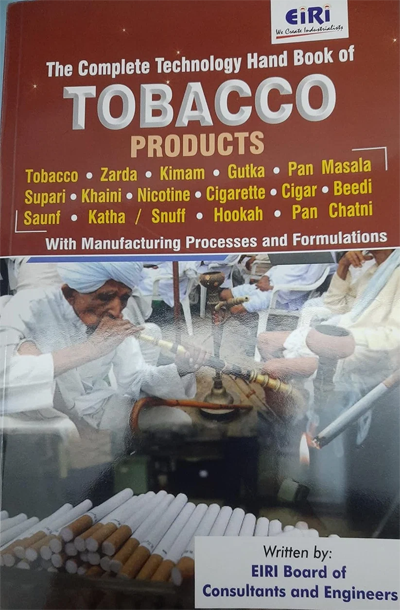
The Complete Technology Hand Book Of Tobacco, Zarda, Kimam, Gutka, Pan Masala, Mouth Freshner, Supari, Khaini, Nicotine, Cigarette, Cigar, Beedi, Saunf, Katha/Snuff, Hookah, And Pan Chatni With Manufacturing Processes And Formulations
The Complete Technology Hand Book Of Tobacco, Zarda, Kimam, Gutka, Pan Masala, Mouth Freshner, Supari, Khaini, Nicotine, Cigarette, Cigar, Beedi, Saunf, Katha/Snuff, Hookah, And Pan Chatni With Manufacturing Processes And Formulations
Couldn't load pickup availability
The Complete Technology Hand Book of Tobacco, Zarda, Kimam, Gutka, Pan Masala, Mouth Freshner, Supari, Khaini, Nicotine, Cigarette, Cigar, Beedi, Saunf, Katha/Snuff, Hookah, and Pan Chatni with Manufacturing Processes and Formulations (Engineers India Research Institute, ISBN 9789380772943) is a technical reference documenting the tobacco crop from field to finished product.
The agronomy section covers origin and distribution of production, climate, altitude, temperature, rainfall, humidity and soil requirements, improved varieties under each tobacco type, nursery bed location and preparation, seed and sowing, summer and kharif tillage, fertiliser application, transplanting time and spacing, topping and desuckering, weed control and crop rotation. Diseases and insect pests are treated individually with control measures, including damping off, black shank, powdery mildew, anthracnose, leaf curl, tobacco mosaic, root knot, tobacco caterpillar, looper, stem borer, ground beetles, green peach aphid, tobacco capsule borer and cigarette beetle.
Harvesting and curing chapters explain priming and stalk-cut harvesting and all four curing methods — flue, air, fire and sun — followed by grading systems for Flue Cured Virginia, Burley, Lanka, Natu, HDBRG, Jati, Motihari, cigar wrapper, cigar filler and bidi tobaccos, with farm grade specifications for Northern Light Soils, Karnataka Light Soils and black soil regions.
Remaining chapters document processing technology and formulations, raw materials including betel nut, catechu and lime, flavour and essence chemistry, eatable food colours, packaging machinery, Indian licensing procedure, and project profiles giving plant and machinery lists, fixed capital, raw material costs, working capital and annual turnover figures.
Frequently Asked Questions
What does The Complete Technology Hand Book of Tobacco cover?
The Complete Technology Hand Book of Tobacco (EIRI, ISBN 9789380772943) covers the tobacco value chain end to end. Its major divisions are: crop agronomy and cultivation practice; disease and insect pest control; harvesting and the four curing methods; official grading systems and farm grade specifications; processing technology and manufacturing formulations; flavour, essence and food colour chemistry; packaging machinery; Indian licensing and government procedure; and project profiles with detailed plant economics.
Who is this tobacco technology handbook written for?
This handbook is written for readers who need process-level technical detail rather than an introduction to the subject. Its intended audience includes agricultural scientists and extension officers, students of agronomy and agri-processing, technical and institutional libraries, licensed manufacturers already operating in the sector, and consultants preparing feasibility studies or detailed project reports.
Does the book cover tobacco cultivation and agronomy, or only processing?
The book covers both, with a substantial opening section devoted to cultivation. Agronomy topics include origin and distribution of production, altitude, temperature, rainfall and humidity requirements, soil types, improved varieties under each tobacco type, nursery raising, seed and sowing, summer and kharif tillage, fertiliser application, transplanting time and spacing, topping and desuckering, weed control, crop rotation, and control measures for major diseases and insect pests.
Which tobacco curing methods and grading standards does the book explain?
The book explains all four curing methods and the grading systems that follow them. Flue curing is broken into yellowing, fixing colour, leaf drying, midrib drying and bulking; air curing, fire curing and sun curing are covered separately. Grading content includes grade designations and quality definitions for unmanufactured Flue Cured Virginia grown in the Northern Light Soils of Andhra Pradesh and Karnataka, the plant position grading system used in Northern Light Soils, ten farm grades for black soil tobacco, and grading practice for Burley, Lanka, Natu, HDBRG, Jati, Motihari, cigar wrapper, cigar filler and bidi types.
Does the book include manufacturing formulations, process flow sheets and machinery lists?
Yes. Processing chapters are supported by process flow sheets, machinery lists and raw material lists across product categories, together with packaging machinery coverage spanning powder filling, bottom sealing, polybag and pouch packing, homogenisers, tube filling and sealing, label gumming and cap sealing. This material is presented as technical documentation of existing industrial practice.
What Indian government policy and licensing information does the book contain?
A dedicated chapter sets out Indian licensing procedure for tobacco. It describes the L-1 licence for tobacco farming, the L-2 licence, and the L-3 industrial licence, along with the application process, the E B-3 register, statutory health warning requirements, and a list of tobacco research centres in India.
What kind of project profiles and cost data does the book provide?
The closing section provides project profiles, each following a consistent structure: manufacturing process, process flow diagram, plant and machinery list, fixed capital, raw materials, total working capital per month, total capital investment and annual turnover. Profiles cover units such as machine-made beedi, chewing tobacco, cigarettes, herbal cigarettes, katha and kutch, nicotine sulphate from tobacco waste, pan masala, scented sweet supari and chikni supari, silver coated cardamom, and zarda and kimam.
What is the regulatory position on the products described in this book?
Indian law restricts several of the products documented in this book. FSSAI regulations prohibit tobacco and nicotine as ingredients in food products, and Indian states have notified bans on the manufacture, storage and sale of gutkha and tobacco-containing pan masala. COTPA 2003 governs advertising, packaging and warning requirements for tobacco products. This handbook documents technology and historical industrial practice; it is not a guide to lawful commercial operation, and the current statutory position must be verified independently.
Share