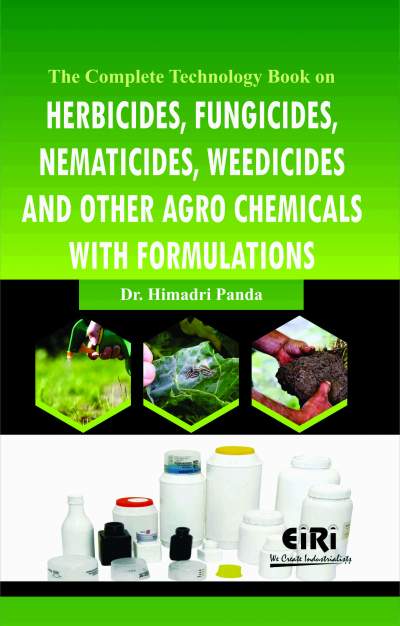
The Complete Technology Book On Herbicides, Fungicides, Nematicides, Weedicides And Other Agro Chemicals With Formulations
The Complete Technology Book On Herbicides, Fungicides, Nematicides, Weedicides And Other Agro Chemicals With Formulations
Couldn't load pickup availability
The Complete Technology Book on Herbicides, Fungicides, Nematicides, Weedicides and Other Agro Chemicals with Formulations (Engineers India Research Institute, ISBN 9788193863916) is a technical reference covering crop protection chemistry from synthesis through to field application.
The herbicide section documents the production of phenoxy herbicides, including the manufacture of 2,4-D, its reactions and uses, production of 2,4-dichlorophenoxyacetate, conversion to the active species, ester production and formulation into a user product, along with environmental implications. Further chapters cover paraquat dichloride calixarene complexes, preparation of bromacil/diuron complexes, processes for glyphosate and its derivatives, and the preparation of substituted phenylureas. A detailed applications chapter examines weed factors such as identification, morphology, height and vegetative mass; crop factors including species, growth stage, tolerance and morphology; and herbicide factors covering type, timing, formulation, labelling, resistance and selection pressure, sprayer selection and calibration.
The fungicide section explains the role of fungicides in disease management, application methods and fungicide classification, then examines the novel fungicide fenpyrazamine in depth - discovery route, synthesis, manufacturing methods, antifungal spectrum, physical properties and formulation - supported by tables on activity, toxicity, mutagenicity and ecotoxicology. Macrocyclic cyclododecanone derivatives and a process for reducing by-products in carbendazim preparation are also covered.
Nematicide chapters address carbamates and organophosphates, fumigants including 1,3-dichloropropene, sodium tetrathiocarbonate, metam sodium, dazomet and methyl isothiocyanate, with efficacy and side-effect analysis. Closing sections cover atrazine immunoconjugates and ELISA development, alkylpolysiloxane adjuvants, and plant economics for pesticide emulsifier, aerosol insecticide spray and weedicide units.
Frequently Asked Questions
What does The Complete Technology Book on Herbicides, Fungicides, Nematicides and Weedicides cover?
The Complete Technology Book on Herbicides, Fungicides, Nematicides, Weedicides and Other Agro Chemicals (EIRI, ISBN 9788193863916) covers agrochemical manufacture and use across four product classes. Its main divisions are: herbicide synthesis and formulation, including phenoxy herbicides, glyphosate, paraquat, substituted phenylureas and bromacil/diuron; herbicide application practice and resistance management; fungicide chemistry, with detailed treatment of fenpyrazamine and carbendazim; nematicide chemistry covering carbamates, organophosphates and fumigants; adjuvant and emulsifier technology; residue detection by ELISA; and plant economics for three manufacturing units.
Who is this agrochemical technology handbook written for?
This handbook is written for readers who need synthesis routes, formulation detail and application parameters rather than a general introduction to crop protection. Its intended audience includes agrochemical and formulation chemists, pesticide manufacturing and quality control staff, agronomists and extension officers advising on herbicide application, students and researchers in agricultural chemistry, technical libraries, and consultants preparing feasibility or project reports for formulation units.
Who should consider entering the agrochemical formulation industry, and why?
Agrochemical formulation suits entrants with a chemistry or chemical-engineering background who can meet India's registration requirements, since market access depends on regulatory approval rather than on plant capacity alone. The sector attracts entrants because formulation units require substantially lower capital than technical-grade synthesis plants, demand is tied to cropping cycles across a large agricultural base, and generic off-patent molecules allow smaller manufacturers to compete on formulation quality and distribution. The constraints are equally concrete: every product requires registration with the Central Insecticides Board and Registration Committee under the Insecticides Act 1968, plus a manufacturing licence from the state agriculture department; bioefficacy and toxicology data packages take time and money to assemble; and the sector carries continuing liability for worker safety, storage and environmental compliance. Prospective entrants should confirm the current registration status of any molecule before committing capital.
Does the book include herbicide synthesis routes and manufacturing processes?
Yes. The book documents manufacturing processes rather than describing products only. Herbicide process content includes the production of 2,4-D from 2,4-dichlorophenoxyacetate through conversion to the active species and ester formation, a process for preparing glyphosate and glyphosate derivatives, preparation of substituted phenylureas, preparation of bromacil/diuron complexes, and synthesis and characterisation of paraquat dichloride calixarene molecular complexes.
What does the book explain about herbicide application and resistance?
A dedicated applications chapter sets out the variables that determine whether a herbicide treatment succeeds. It groups these into weed factors (identification, morphology, height and vegetative mass), crop factors (species and variety, growth stage, herbicide tolerance, morphology) and herbicide factors (status and type, time of application, formulation choice, label and technical pamphlet interpretation, resistance and selection pressure, sprayer selection and calibration). Field photographs illustrate selective control failures, weed population shifts from repeated broad-leaf killer use, and crop toxicity from herbicide residues left in spray tanks.
How detailed is the fungicide coverage?
Fungicide coverage combines general principles with a full case study. General content explains what fungicides are, why they are needed, their role in disease management, application methods and classification. The fenpyrazamine case study traces discovery from the lead compound through structure-activity relationships to the final molecule, then covers the synthesis route, manufacturing methods, antifungal spectrum, physical properties and water-dispersible formulation, with tables on acute, subacute, chronic, developmental, reproductive, neuro- and immunotoxicity, mutagenicity and ecotoxicology on non-target organisms.
What nematicides and fumigants does the book cover?
Nematicide coverage spans both chemical classes in commercial use. Carbamates covered include aldicarb, aldoxycarb, carbofuran and oxamyl; organophosphates include phorate, chlorpyrifos and triazophos. Fumigant content covers 1,3-dichloropropene and D-D mixtures, ethylene dibromide, 1,2-dibromo-3-chloropropane, chloropicrin synthesis, propargyl bromide stabilisation, sodium trithiocarbonate and tetrathiocarbonate, and the metam sodium, dazomet and methyl isothiocyanate group, alongside a chapter on the efficiency and side-effects of chemical nematode control and a table of recommended nematicidal dosages for important crops.
What is the regulatory position on the compounds described in this book?
Registration status varies by compound and changes over time. Several substances documented in this book — including certain fumigants and carbamates — have since been banned, withdrawn or restricted in India and other jurisdictions, and permitted crops, dosages and application methods are revised periodically. In India, manufacture, import, sale and use of any pesticide requires registration with the Central Insecticides Board and Registration Committee under the Insecticides Act 1968. Readers should treat this book as technical documentation and verify the current regulatory status of any molecule with CIB&RC before use or commercial production.
Share