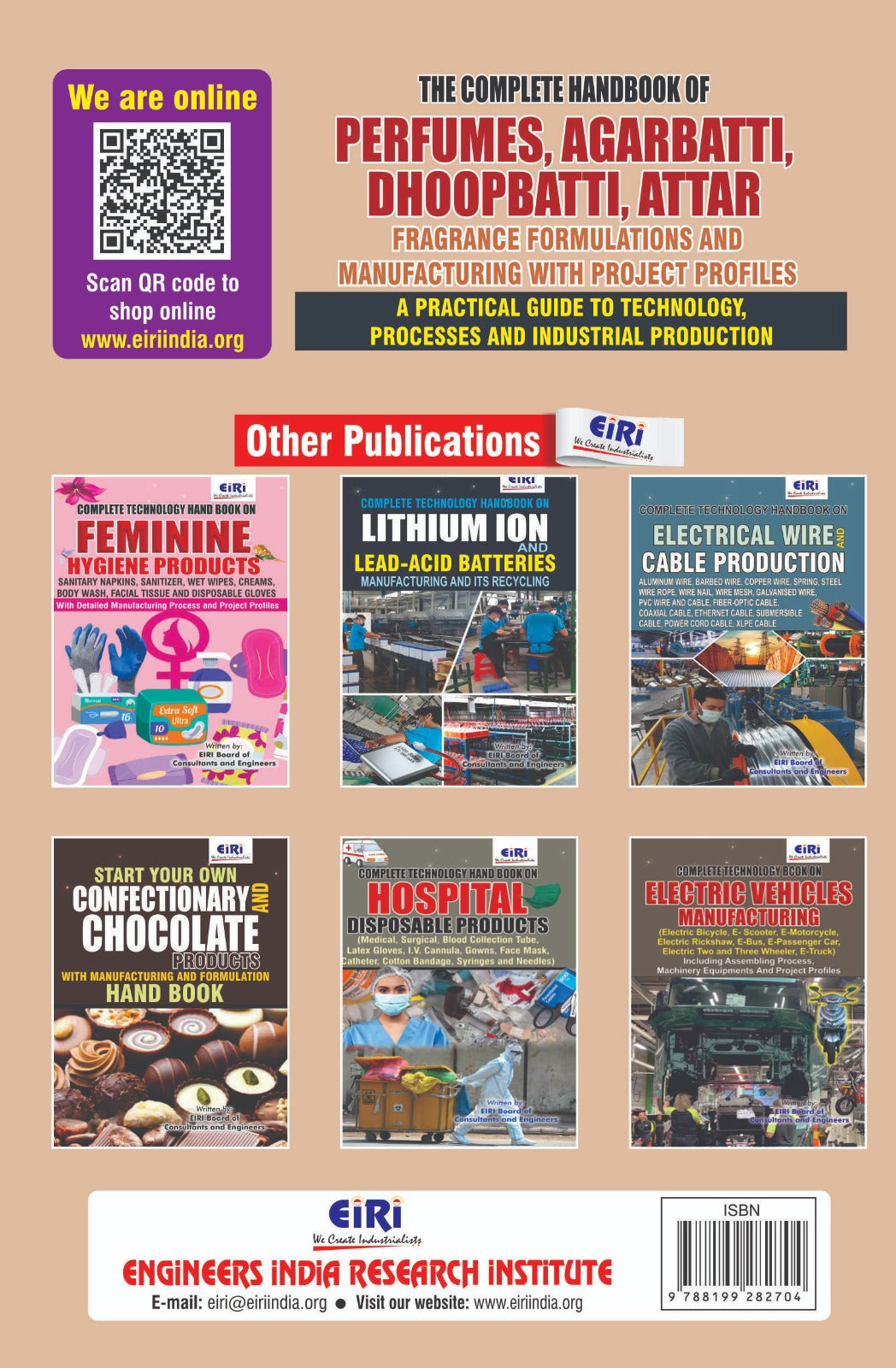
The Complete Handbook of Perfumes, Agarbatti, Dhoopbatti, Attar, Fragrance Formulations and Manufacturing with Project Profiles (A Practical Guide to Technology, Processes and Industrial Production)
The Complete Handbook of Perfumes, Agarbatti, Dhoopbatti, Attar, Fragrance Formulations and Manufacturing with Project Profiles (A Practical Guide to Technology, Processes and Industrial Production)
Couldn't load pickup availability
About This Book
The Complete Handbook of Perfumes, Agarbatti, Dhoopbatti, Attar, Fragrance Formulations and Manufacturing with Project Profiles (A Practical Guide to Technology, Processes and Industrial Production) (Engineers India Research Institute) is a formulation-led reference for perfumery compounds and incense manufacture, built around numbered working formulae.
Raw material sections cover the chemical building blocks of perfumery, including linalool, citral and geraniol, and the formate, acetate and propionate ester families used across compositions, alongside extraction by volatile solvent, maceration in warm fats and cold fat enfleurage. Floral fragrance sections work through the principal notes — acacia, carnation, cyclamen, gardenia, geranium, hyacinth, jasmine, lilac, lily of the valley, mimosa, narcissus, orris, peony, reseda, rose, sweet pea and wallflower — with the aroma chemicals associated with each, followed by fruit, spice, berry and nut notes and balsamic, pine, oriental and woody odours.
Formulation sections give working formulae by application. These cover perfumes for hair oils including amla, rose, violet and lavender types; attar and otto formulae for rose, jasmine, narcissus, broom and amla; synthetic perfume compounds; agarbatti perfumery compounds with rose, jasmine, pandanus, lavender, lilac and lily of the valley fragrances at mild, strong and high quality grades; dhoopbatti ingredients and manufacture; perfumes for cosmetics across brilliantines, shampoos, face and talcum powders, creams, rouges, lipsticks, hair creams, dental creams and toothpastes; and fifty numbered soap perfume formulations covering toilet, transparent, laundry and shaving soaps.
Further sections cover fantasy and sophisticated perfume construction through aldehydic, chypre, oriental, green, woody, moss, cuir and floral bouquet bases, perfumes for men, finished perfume manufacture with alcoholic strength control, alcohol-free perfume, perfumed sprays, rose oil production by water, water and steam and steam distillation, perfuming and repacking of dummy incense sticks, supplier listings and project profiles.
Frequently Asked Questions
What does the Complete Handbook of Perfumes, Agarbatti, Dhoopbatti and Attar cover?
This handbook covers perfumery compound and incense manufacture through working formulations. Its main divisions are: perfume composition principles and raw materials; aroma chemical families and floral, fruit, spice and balsamic notes; formulations for hair oils, attars and ottos; synthetic perfume compound manufacture; agarbatti and dhoopbatti perfumery with fragrance formulations and perfuming methods; perfumes for cosmetics, soaps and shaving products; fantasy and sophisticated perfume bases; finished perfume manufacture and sprays; rose oil production by distillation; supplier listings for materials and machinery; and project profiles with capital and turnover figures.
Who is this perfumery and agarbatti handbook written for?
This handbook is written for readers who need working formulae rather than an introduction to fragrance. Its intended audience includes agarbatti and dhoopbatti manufacturers, perfumery compound producers supplying the incense and cosmetic trades, attar makers, soap and cosmetic manufacturers formulating their own fragrance, small manufacturers moving from buying compounds to blending their own, students of cosmetic technology, technical libraries, and entrepreneurs preparing project reports for an agarbatti or perfumery compound unit.
Who should consider starting an agarbatti or perfumery compound business, and why?
Agarbatti manufacture is one of the most accessible manufacturing entries in India and suits entrants with limited capital, including household and self-help group operations, because the core activities are blending, rolling or dipping, perfuming and packing rather than reaction chemistry. Demand is year-round with festival peaks, distribution can start locally before widening, and raw sticks can be bought in so a unit may begin with perfuming and packing alone before adding rolling capacity. Perfumery compound manufacture sits a step above: it supplies agarbatti, soap and cosmetic makers as a business-to-business input, requires blending skill and a nose rather than heavy plant, and earns better margins than finished incense. The constraints are worth stating. Fragrance quality is the whole product, and formulation skill takes time to build or must be hired. Aroma chemicals and essential oils are import-linked and price-volatile. Finished agarbatti is a crowded, price-competitive market where established brands dominate retail shelves, so most small units succeed through local distribution, institutional supply or contract manufacture rather than by launching a national brand. Raw material adulteration is common and affects both cost and consistency.
Does the book include actual perfume formulations?
Yes, and this is the core of the book. Formulations are numbered and grouped by application rather than by chemistry, so a reader can locate a formula by what they are making. Coverage includes fifty soap perfume formulations spanning rose, jasmine, violet, lilac, almond, sandal, lavender, champak, ginger grass, pine and vanilla types across toilet, transparent, laundry and shaving soaps; cosmetic perfume formulations for brilliantines, shampoos, face and talcum powders, creams, rouges, lipsticks, hair creams and dental products; thirteen hair oil perfume formulations; attar and otto formulae; and agarbatti fragrance formulations at mild, strong and high quality grades with process notes.
What does the book cover on agarbatti and dhoopbatti manufacture?
Incense coverage runs from fragrance formulation through to packing. Agarbatti content covers synthetic flower fragrances for incense including rose in mild and strong grades, Chinese rose compound, jasmine at mild and high quality grades, jasmine bouquet, pandanus essence, vitavest, lavender, lilac and lily of the valley, along with perfume powder and colourless synthetic jasmine, each with manufacturing process notes. Dhoopbatti content covers typical production ingredients, a formula for essential ingredients in synthetic dhoopbatti and the manufacturing method. A separate section covers perfuming and repacking as a business in itself, including procurement of dummy incense sticks, preparation of flavours, the method of perfuming, boxes and pouches for packing, and packing method.
What project economics does the book provide?
The book includes five project profiles, each covering plant and machinery, fixed capital, raw materials, monthly working capital, total capital investment and annual turnover. The projects are: flora agarbatti; agarbatti perfumery compounds with formulation; alcohol-based deodorant manufacturing; masala agarbatti; and non-alcoholic deodorant perfume spray. Additional plant economics appear within the chapters on agarbatti perfumery compounds, semi-solid perfume compounds and perfumed sprays, each with machinery, fixed capital, raw material and turnover figures.
Does the book explain essential oil and rose oil production?
Yes. A dedicated section covers rose oil production with worked examples and comparative characteristics of oil produced from fresh rose flowers, alongside rose oil standards, properties and uses. Distillation content covers water distillation, water and steam distillation and steam distillation with a process flow chart. Further extraction content covers volatile solvent extraction, jasmine oil extraction, distillation of roses and lavender oil extraction with instructions. Essential oil production methods are also covered for citronella, lemongrass, eucalyptus and sandalwood oils, with reference to Indian standards.
How does this book differ from other perfumery titles?
This title is formulation-led and oriented toward the Indian incense and perfumery compound trade. Its emphasis falls on numbered working formulae for agarbatti, dhoopbatti, attars, hair oils, soaps and cosmetics, together with the perfuming and packing operations those businesses run. Readers whose primary need is extraction and distillation technology, aerosol and deodorant manufacture, export procedure, or cosmetic standards and factory layout may find a broader companion volume in this series a better fit, and the two are complementary rather than overlapping for anyone working across both formulation and plant operations.
Share