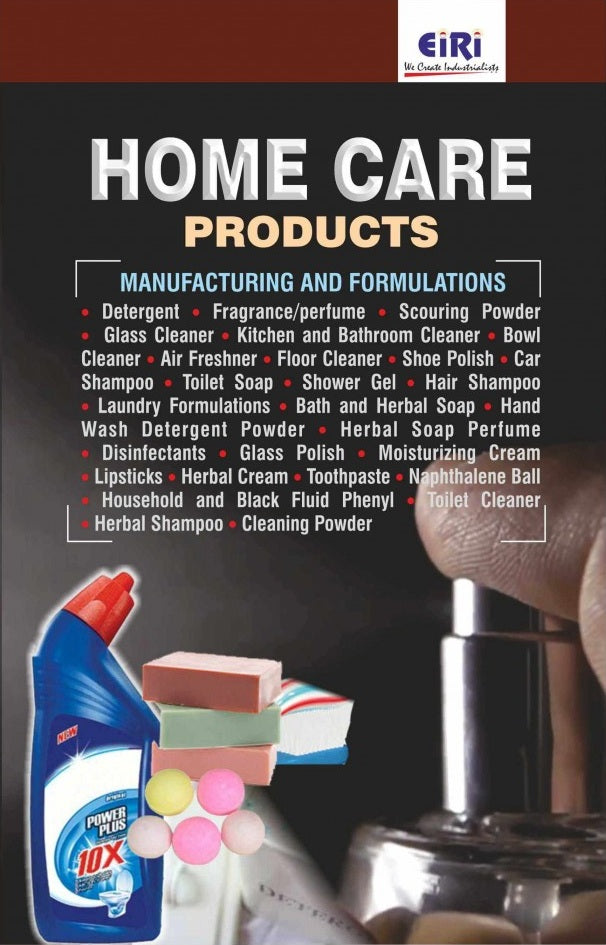
Home Care Products Manufacturing And Formulations
Home Care Products Manufacturing And Formulations
Couldn't load pickup availability
Home Care Products Manufacturing and Formulations (Engineers India Research Institute, ISBN 9788193971307) covers household and laundry product manufacture through working formulations, paired with an unusually large set of costed project estimates.
Ingredient sections cover detergent ingredients, builders including zeolite systems, detergent polymers, complexing and dispersing agents, bleach systems for laundry, dishwasher, toilet and hygiene cleaners with hypohalite and bromide releasing compounds, enzymes, antimicrobial agents and preservatives, fluorescent whitening agents and UV protection additives, fragrance oils with odour thresholds, odour absorbers and colorants, and a dedicated surfactant section covering commodity and specialty types.
Laundry sections cover detergency and the full product range: extruded heavy duty detergents, heavy duty tablets, colour and liquid heavy duty detergents, powder and liquid specialty detergents, pretreatment aids, boosters, aftertreatment aids, fabric softeners, stiffeners, dryer aids, refreshing products and odour removers. A large formulation chapter gives numbered liquid and powder laundry formulations with applications and mixing instructions for each, covering alkaline and non-phosphate builds, two-part built liquids for healthcare, hospitality and industrial laundry, concentrated light-duty liquids, blood stain remover, prespotter, built and light-duty powders with bleach and enzymes, and shirt laundry grades.
Household sections give compositions for hand and automatic dishwashing detergents, liquid all-purpose cleaners, scouring powders, glass cleaners, kitchen and bathroom cleaners, toilet bowl cleaners, rim-blocks and air fresheners, furniture care, floor cleaners, shoe polishes, disinfectants, phenyl and black fluid, glass and gold polish, and car care products including prewash, shampoo, windscreen cleaner, wash and wax and paintwork cleaners. Soap sections cover toilet soaps, detergent bars, cold process and remelt herbal soaps, transparent and glycerine soaps with soap perfumery, alongside institutional and food industry cleaners, and twenty-four chapters of cost estimation and plant economics.
Frequently Asked Questions
What does Home Care Products Manufacturing and Formulations cover?
Home Care Products Manufacturing and Formulations (EIRI, ISBN 9788193971307) covers household and laundry product manufacture from raw material function to costed plant. Its main divisions are: detergent ingredients, builders, bleach systems, enzymes, antimicrobials, whitening agents, fragrances and surfactants; laundry detergents in powder, liquid, tablet and extruded forms with laundry aids; numbered liquid and powder laundry formulations with mixing instructions; dishwashing, all-purpose, glass, kitchen, bathroom, toilet and floor cleaner compositions; polishes, disinfectants and phenyl; car care products; toilet soaps, detergent bars and herbal soaps with soap perfumery; institutional and food industry cleaners; selected personal care formulations; and twenty-four cost estimation chapters.
Who is this home care products handbook written for?
This handbook is written for readers who need formulae they can put into production. Its intended audience includes detergent and household cleaning product manufacturers, soap and detergent bar producers, formulators developing laundry and surface cleaner ranges, small and medium enterprise owners making phenyl, floor cleaner, dishwash and toilet cleaner, institutional and industrial cleaning chemical suppliers, quality control staff, students of industrial chemistry, technical libraries, and entrepreneurs or consultants preparing project reports for a home care products unit.
Does the book include actual formulations?
Yes, and formulations run through almost every chapter. Laundry content gives numbered liquid and powder formulations, each with its applications and step-by-step mixing instructions, across alkaline built, non-phosphate, two-part built, concentrated light-duty, bleach-containing, enzyme-containing, economy and shirt laundry grades, plus blood stain remover and prespotter. Household content gives typical compositions for dishwashing detergents, all-purpose cleaners, scouring powders, glass cleaners, kitchen and bathroom cleaners, toilet bowl cleaners, rim-blocks, air fresheners, furniture care, floor cleaners and shoe polishes. Further formulations cover phenyl and black fluid in several quality grades, water soluble and vegetable oil based disinfectants, glass polish, gold polish and scratch remover, car prewash, shampoo, windscreen cleaner, wash and wax and polish, and toilet, transparent, glycerine and herbal soaps with their perfume formulations.
Who should consider starting a home care products business, and why?
Home care products are among the most practical manufacturing entries available, and this book is organised for exactly that reader. Most products in the category are mixing, blending and filling operations rather than reaction chemistry, so a single facility with mixing vessels, a filling line and packing can produce floor cleaner, phenyl, dishwash, toilet cleaner, hand wash and detergent powder from the same floor space. Demand is repeat-purchase and consumed continuously, which gives steady reordering independent of economic cycles. Raw materials including surfactants, soda ash, acid slurry and fragrances are available through established Indian suppliers. The product ladder lets a unit start with one or two lines and widen the range as distribution grows, and the twenty-four costed chapters let an entrant compare capital requirements across products before committing. Entrants do best supplying local and regional distribution, institutional buyers such as hotels, hospitals and offices, and private label contracts, where formulation quality and reliable supply matter more than advertising budget.
How much cost estimation and plant economics does the book include?
Twenty-four chapters give cost estimation or plant economics, each covering plant and machinery, fixed capital, raw materials, monthly working capital, total capital investment and annual turnover. The units costed are: bath soap in several types; bath soap manufacturing; glass and surface cleaner; scouring and detergent cake; detergent cake and powder together; spray dried detergent powder; SLES based dishwashing liquid; floor cleaner; high foaming perfumed hand wash; hand washing detergent powder; laundry and dry cleaning; liquid soap with liquid detergent; perfumed toilet soap; perfumes for soap, detergent and agarbatti; scouring bar; soap and detergent combined; toilet bowl cleaner with hand dishwasher liquid; toilet soap in cake form; washing powder with washing soap; liquid antistatic floor cleaner; wax floor polish; white wood polish; a glass cleaner unit; and cleaning powder. This makes it straightforward to compare capital and turnover across the whole category before selecting a product mix.
What laundry detergent content does the book cover?
Laundry is the most developed subject in the book, covered from chemistry to finished grade. Ingredient content covers detergency itself, builders including zeolite systems, detergent polymers, complexing agents and dispersants, bleach systems for laundry use, enzymes, fluorescent whitening agents, UV protection additives and fragrance oils selected for laundry detergents with odour threshold data. Product content covers extruded heavy duty detergents, heavy duty tablets, colour-safe and liquid heavy duty detergents, and powder and liquid specialty detergents. Laundry aid content covers pretreatment aids, boosters, aftertreatment aids, fabric softeners, stiffeners, dryer aids, refreshing products for dryer application and odour removers for washer application. Formulations are then given for institutional, healthcare, hospitality, industrial and commercial laundry duty, each with applications and mixing instructions.
What household and surface cleaner formulations does the book give?
Household coverage spans every surface a cleaning range needs to address. Kitchen and dishwashing content covers hand dishwashing detergents, institutional and domestic automatic dishwashing detergents with their bleach systems, and scouring powders and dispersions. Surface content covers liquid all-purpose cleaners, glass cleaners, kitchen and bathroom cleaners, floor cleaners including a liquid antistatic type, and furniture cleaner and care products. Sanitary content covers liquid and granulated toilet bowl cleaners, toilet rim-blocks, air fresheners, and bleach systems for toilet and hygiene cleaners. Disinfectant content covers phenyl in household and black fluid types across quality grades, coal tar and cresol based fluids, water soluble and vegetable oil based disinfectants, and germicidal activity data for alkyl and halogenated phenols. Specialist content covers shoe polishes, wax floor polish, white wood polish, glass and gold polish, scratch remover, naphthalene balls and camphor tablets, foam cleaners for abattoirs, butchers, dairies and food processing, and cleaners for offices and public buildings.
Does the book also include personal care formulations?
Yes, a set of personal care products is covered alongside the home care range, which lets a manufacturer widen into adjacent categories on similar equipment. Formulations are given for a moisturising cream with aloe vera, a herbal all purpose cream, gel type transparent toothpaste, herbal shampoo, a mild hair shampoo, a mild moisturising shower gel, and lipsticks and other lip products with their wax, oil, acetoglyceride, colour and additive composition. Each of the cream, toothpaste and shampoo chapters covers the properties required of a good quality product, uses and applications, raw materials and their availability, the formulation itself, the manufacturing process and the plant and machinery needed. Soap content covers toilet soaps, detergent bars, cold process and remelt bathing soaps, transparent and glycerine soaps, and herbal soap perfumes.
Share