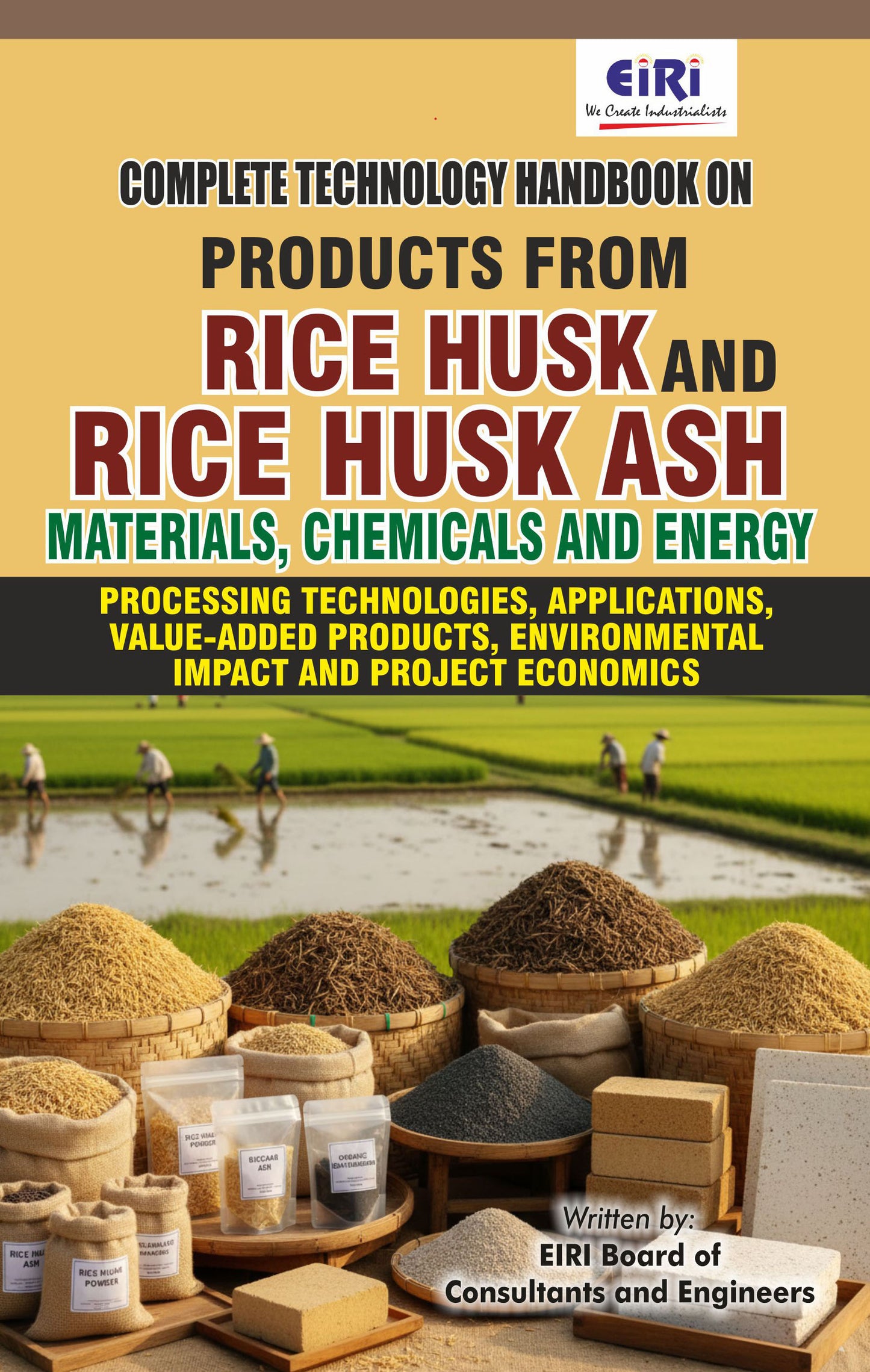
Complete Technology Handbook on Products from Rice Husk and Rice Husk Ash: Materials, Chemicals and Energy (Processing Technologies, Applications, Value-added Products, Environmental Impact and Project Economics)
Complete Technology Handbook on Products from Rice Husk and Rice Husk Ash: Materials, Chemicals and Energy (Processing Technologies, Applications, Value-added Products, Environmental Impact and Project Economics)
Couldn't load pickup availability
Complete Technology Handbook on Products from Rice Husk and Rice Husk Ash: Materials, Chemicals and Energy (Processing Technologies, Applications, Value-added Products, Environmental Impact and Project Economics) (Engineers India Research Institute, ISBN 9788193971390) documents the conversion of paddy milling residue into industrial materials, chemicals and energy across 33 chapters in ten parts.
Opening chapters establish the fundamentals: rice husk forms and composition, proximate and ultimate analysis, organic and inorganic fractions, physical and rheological properties, composting, stress-strain behaviour, storage systems and dust-safe handling. Rice husk ash chapters cover physical properties, chemical composition, microstructure and pozzolanic reactivity, with characterisation by X-ray diffraction, scanning electron microscopy, thermogravimetric analysis, FTIR and surface area measurement.
Product chapters then work through the full value ladder. Silica and silicon routes cover precipitated silica with rubber, paint, pesticide, toothpaste and micronised grades, nano-silica synthesis, silica aerogels, silicon-based polymers and silicon wafer production. Carbon routes cover activated carbon preparation, activation methods and specifications, and biochar via conventional and hydrothermal carbonisation with soil conditioning and heavy metal adsorption applications. Energy chapters address gasification technologies, power and cogeneration systems, and cellulosic ethanol through simultaneous saccharification and fermentation, distillation and purification.
Further chapters cover cement, lime and gypsum products from RHA, particle board and hardboard with adhesive systems, bricks, blocks and panels with mix design and strength testing, paper and pulp, packaging materials, and oxalic acid manufacture. Closing parts address market analysis, techno-economic feasibility, plant layout and utilities, machinery photographs with supplier contacts, carbon credits and life-cycle assessment, government schemes, BIS/ASTM/ISO standards, dust explosion and fire safety, commercial case studies, and plant economics for six projects.
Frequently Asked Questions
What does the Complete Technology Handbook on Products from Rice Husk and Rice Husk Ash cover?
The Complete Technology Handbook on Products from Rice Husk and Rice Husk Ash (EIRI, ISBN 9788193971390) covers rice husk valorisation from raw material characterisation to project finance. Its ten parts are: rice husk fundamentals and characterisation; rice husk ash properties and industrial applications; silica and silicon products; activated carbon and biochar; energy and fuels; building materials and boards; agricultural, paper and packaging products; chemicals including oxalic acid; business, economics and policy; and quality, safety and future trends.
Who is this rice husk technology handbook written for?
This handbook is written for both technical and commercial readers. Its intended audience includes materials scientists and chemical engineers working on biomass valorisation, researchers and postgraduate scholars in sustainable materials, rice millers and biomass processors seeking to use husk streams, entrepreneurs and consultants preparing project reports, environmental technologists assessing carbon and life-cycle impacts, and technical libraries.
Who should consider starting a rice husk processing business, and why?
Rice husk processing suits three groups in particular: rice millers with captive husk generation, who already control the feedstock and pay to dispose of it; biomass and renewable energy entrepreneurs operating in paddy-growing districts; and chemical or materials entrepreneurs targeting silica, silicon and activated carbon markets. The sector is attractive because feedstock is abundant and cheap in rice-producing regions, entry is possible at several capital levels — briquetting and pelletising at the low end, precipitated silica and sodium silicate in the middle, ultra-pure silicon at the top — and projects often qualify for renewable energy incentives, MSME schemes and carbon credit revenue. The constraints matter equally: husk has low bulk density, so economics depend on siting the plant within a short haulage radius of mills; supply is seasonal and increasingly contested by biomass power plants; higher-value silica and silicon products demand tight control of ash purity and crystallinity; and husk dust carries a genuine explosion risk that must be engineered out from the design stage.
Does the book explain how to extract silica and silicon from rice husk ash?
Yes. Silica and silicon extraction is covered across two dedicated chapters. Precipitated silica content includes the manufacturing process, process flow diagram, precipitation and digestion steps, physico-chemical characteristics, and grade specifications for rubber, non-rubber, pesticide, paint, toothpaste and micronised applications. Advanced products covered include nano-silica synthesis with thermal treatment, extraction, acidity and lime reactivity measurement and morphology assessment, plus silica aerogels, silicon-based polymers, silicon wafer production and emerging electronics and energy applications.
What energy and fuel products from rice husk does the book cover?
Energy coverage spans thermochemical and biotechnological routes. Electricity chapters explain biomass energy pathways, gasification technologies and reactor implementations, power generation and cogeneration systems, their benefits, challenges and social impact. Fuel chapters cover cellulosic ethanol production through simultaneous saccharification and fermentation, filtration and distillation, dinitrosalicylic acid analysis, purification by distillation and adsorption, fermentation by-products, potential yields, and ethanol grades and uses. Briquette and pellet production is addressed with general specifications and applications.
Does the book include plant economics and project cost data?
Yes. Six chapters give plant economics, each covering land and building, plant and machinery, fixed capital, monthly working capital requirement, total capital investment and annual turnover. The projects are: rice husk or wooden waste to briquette; silica recovery from rice husk ash at 30,000 TPA; silicon from rice husk at 30 TPD; sodium silicate from rice husk ash on a dry basis; ultra-pure silicon from rice husk; and a water bottle plant with packaging from biodegradable material made from sugarcane bagasse or rice husk. A separate techno-economic chapter covers capital and operating cost analysis, break-even and ROI.
What does the book say about carbon credits and environmental impact?
A dedicated chapter covers environmental impact and carbon credits, including life-cycle assessment findings for rice husk applications, carbon footprint reduction mechanisms, how rice husk projects generate carbon credits, the factors influencing credit value and market potential, and the negative environmental impacts that arise when husk is left unmanaged. Biochar chapters separately address carbon sequestration potential and its practical limits.
Does the book cover safety, standards and government support schemes?
Yes. Quality control chapters set out rice husk ash characterisation methods and the relevant ASTM, BIS and ISO standards with testing procedures. Safety chapters cover HIRARC risk management, dust explosion hazards with case studies and preventive controls, emission management and aspiration equipment, fire fighting and escape requirements, and the Indian occupational safety legal framework. A policy chapter covers central government schemes, state-level incentives, eligible project types, renewable energy incentives, pollution control regulation and how to access support.
Share