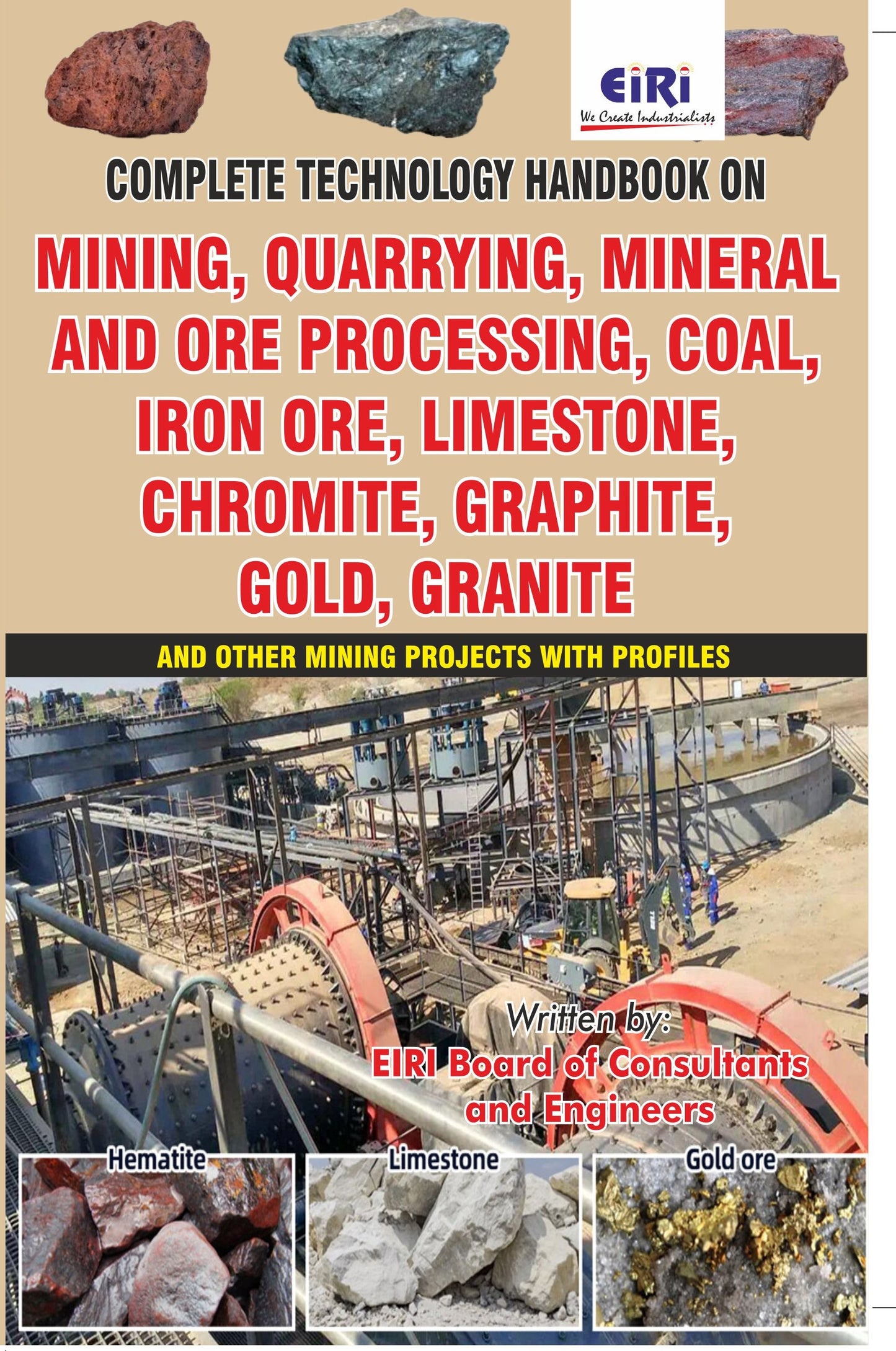
Complete Technology Handbook On Mining, Quarrying, Mineral And Ore Processing, Coal, Iron Ore, Limestone, Chromite, Graphite, Gold, Granite And Other Mining Projects With Profiles
Complete Technology Handbook On Mining, Quarrying, Mineral And Ore Processing, Coal, Iron Ore, Limestone, Chromite, Graphite, Gold, Granite And Other Mining Projects With Profiles
Couldn't load pickup availability
Complete Technology Handbook on Mining, Quarrying, Mineral and Ore Processing, Coal, Iron Ore, Limestone, Chromite, Graphite, Gold, Granite and other Mining Projects with Profiles (Engineers India Research Institute, ISBN 9788189765712) covers extraction, beneficiation and downstream mineral processing alongside project costs.
Mining sections cover the coal mining life cycle from exploration and mine development through open-pit and underground working, ventilation, haulage, coal preparation and rehabilitation, with an extended treatment of mine safety, statutory framework, emergency response, dust and water danger control and occupational health. Further sections cover limestone, granite, graphite, gypsum, potash, copper, gold, iron ore and manganese mining, each with extraction method, processing route and environmental impact, plus the gold mine life cycle from exploration through operation, closure, decommissioning and reclamation.
Processing sections cover crushing and screening across primary, secondary and tertiary stages with jaw, gyratory, cone, impact, roll and vertical shaft impact crushers and mobile plant configurations; beneficiation by gravity, magnetic separation and flotation for chromite, graphite, iron ore and manganese; selective flocculation and reagent design for alumina-rich Indian iron ore slimes; copper smelting and refining through flash smelting, converter, anode furnace and refinery; ferrosilicon production by submerged arc furnace; iron ore pelletization by straight travelling grate and grate kiln; and calcined petroleum coke by rotary, rotary hearth and vertical shaft kiln.
Lime and limestone sections cover quicklime, hydrated and hydraulic lime properties, analytical testing and specifications, vertical and rotary kiln construction, refractory lining selection, precipitated calcium carbonate, dead-burned dolomite, and emission control by electrostatic precipitator, baghouse and selective non-catalytic reduction. Further sections cover silica ramming mass, emery stone, magnesium metal, cobalt carbonate, granite tile cutting and polishing, mine waste and tailings management, conveyor idlers and mining equipment, and fifteen project profiles.
Frequently Asked Questions
What does the Complete Technology Handbook on Mining, Quarrying and Mineral Processing cover?
The Complete Technology Handbook on Mining, Quarrying, Mineral and Ore Processing (EIRI, ISBN 9788189765712) covers mineral extraction through to value-added products. Its main divisions are: mining of coal, limestone, granite, graphite, gold, gypsum, copper, potash, iron ore, chromite and manganese; crushing, screening and beneficiation technology; smelting and metallurgical processing including copper, ferrosilicon, ferrochrome and magnesium; lime and limestone processing with kiln technology; downstream products including calcined petroleum coke, iron ore pellets, silica ramming mass and precipitated calcium carbonate; mine waste and tailings management; mining equipment; and fifteen project profiles with capital and turnover figures.
Who is this mining and mineral processing handbook written for?
This handbook is written for readers who need process and equipment detail across extraction and beneficiation. Its intended audience includes mining and mineral processing engineers, quarry and crusher unit operators, metallurgists working on beneficiation and smelting, lime, refractory and pelletization plant staff, students of mining and metallurgical engineering, technical libraries, and entrepreneurs or consultants preparing project reports for a quarry, crushing or mineral processing unit.
Who should consider entering mining or mineral processing in India, and why?
These are two different businesses with very different barriers, and the distinction matters more here than in most sectors. Mining itself requires a mineral concession from the state government under the Mines and Minerals (Development and Regulation) Act, and concessions for major minerals are now granted through auction rather than application, alongside environmental clearance, forest clearance where applicable, and consent from the state pollution control board. That process suits established players with capital, technical staff and the ability to hold ground through a long approval cycle, not first-time entrants. Mineral processing and downstream conversion is far more accessible: stone crushing and screening units, limestone grinding, hydrated and quicklime plants, silica ramming mass, granite cutting and polishing and pelletization all buy in raw material rather than holding a lease, and need a district-level licence plus pollution control consent rather than a concession. The case for entering the processing side is that demand tracks construction, steel and cement output, plants can be sited close to both quarry and customer, and product ranges extend naturally. The constraints are dust and noise compliance, siting restrictions near habitation and forest land, dependence on lease-holding suppliers for raw material, and freight cost, which dominates economics for low-value high-bulk minerals.
Does the book cover crushing plant selection and configuration?
Yes. Crushing coverage runs across the reduction stages and machine types. It explains primary, secondary, tertiary and final reduction crushing, jaw crushers and their types, gyratory crushers, cone crushers and their types, impact crushers and their types, roll crushers and vertical shaft impactors, together with the comparison between portable and stationary crushing plants and the components, mobility and advantages of mobile crushing plants. Separate sections cover the stone crushing production line process, sand making and shaping, sand washing, plant machinery selection for each crushing stage, and the licences and clearances required to operate a crushing and screening unit.
What lime and limestone processing technology does the book include?
Lime coverage is one of the most detailed sections. Material content covers quicklime, hydrated lime, hydraulic and natural hydraulic lime with grades, physical and chemical properties, and the differences between hydrated lime and quicklime, supported by analytical testing procedures including heat, acid and ball tests and chemical analysis specifications. Process content covers the lime cycle, limestone crushing flow, vertical shaft kiln construction with preheating, calcining and cooling zones, rotary kiln zones and refractory lining selection including magnesite-chrome, magnesite-spinel and dolomite brick, preheater and cooler systems, raw material handling, flue gas treatment, and emission control. Product sections cover precipitated calcium carbonate production and slaking, dead-burned dolomite, selective calcination for hydraulic lime, and lime from oyster shells.
Does the book include project economics and cost data?
Yes, across fifteen project profiles, each covering land and building, plant and machinery, fixed capital, monthly working capital requirement, total capital investment and annual turnover, with several also giving process flow charts, other fixed assets, cost of project and cost of production. The projects are: graphite ore beneficiation at 1,000 tonnes per month; a chrome beneficiation plant; gold mining; a granite mine; graphite mining and beneficiation; hydrated lime; iron ore mining with sponge iron manufacture; an iron ore pelletization plant; limestone mining; limestone powder grinding; marble quarrying; open cast chrome ore mining; quicklime and slaked lime; stone mining; and a stone quarry.
What beneficiation and separation methods does the book explain?
Beneficiation coverage spans the standard separation routes applied mineral by mineral. Chromite beneficiation covers crushing and grinding, gravity separation, magnetic separation, flotation, drying and smelting, with washing and screening, strong magnetic separation, combined magnetic and flotation routes and pyrochemical enrichment. Manganese beneficiation covers washing, screening, gravity, high-intensity magnetic, flotation, fire enrichment and chemical methods. Iron ore coverage includes screening, crushing, grinding, spiral gravity separation and magnetic separation, plus a research-level treatment of froth flotation and selective flocculation for alumina-rich slimes, covering hematite, gibbsite and kaolinite surface structures, reagent molecule design and mineral-starch interaction energies. Graphite processing equipment covered includes vertical stirring mills, flotation cells, hydrocyclones, thickeners, agitation tanks and chamber filter presses.
Does the book address mine safety and waste management?
Yes. Safety content covers the statutory framework for coal mine safety, safety and rescue division activities, mine environment monitoring, water danger management, dust control in mines, safety training and awareness, inspection, emergency response and rescue services, occupational health services, and newer measures including drone use and electronification of ground water and conveyor control. General mining safety content covers common mine hazards, worker safety practices, safety equipment and risk assessment. Waste content covers rock and solid mine waste including overburden, gangue and tailings, liquid mine waste and treatment sludge, tailings storage and management, water management, rehabilitation and post-closure care, green mining practices, and waste recycling plant equipment including bag openers, ballistic separators, bio-drums, windsifters and trommels.
Share