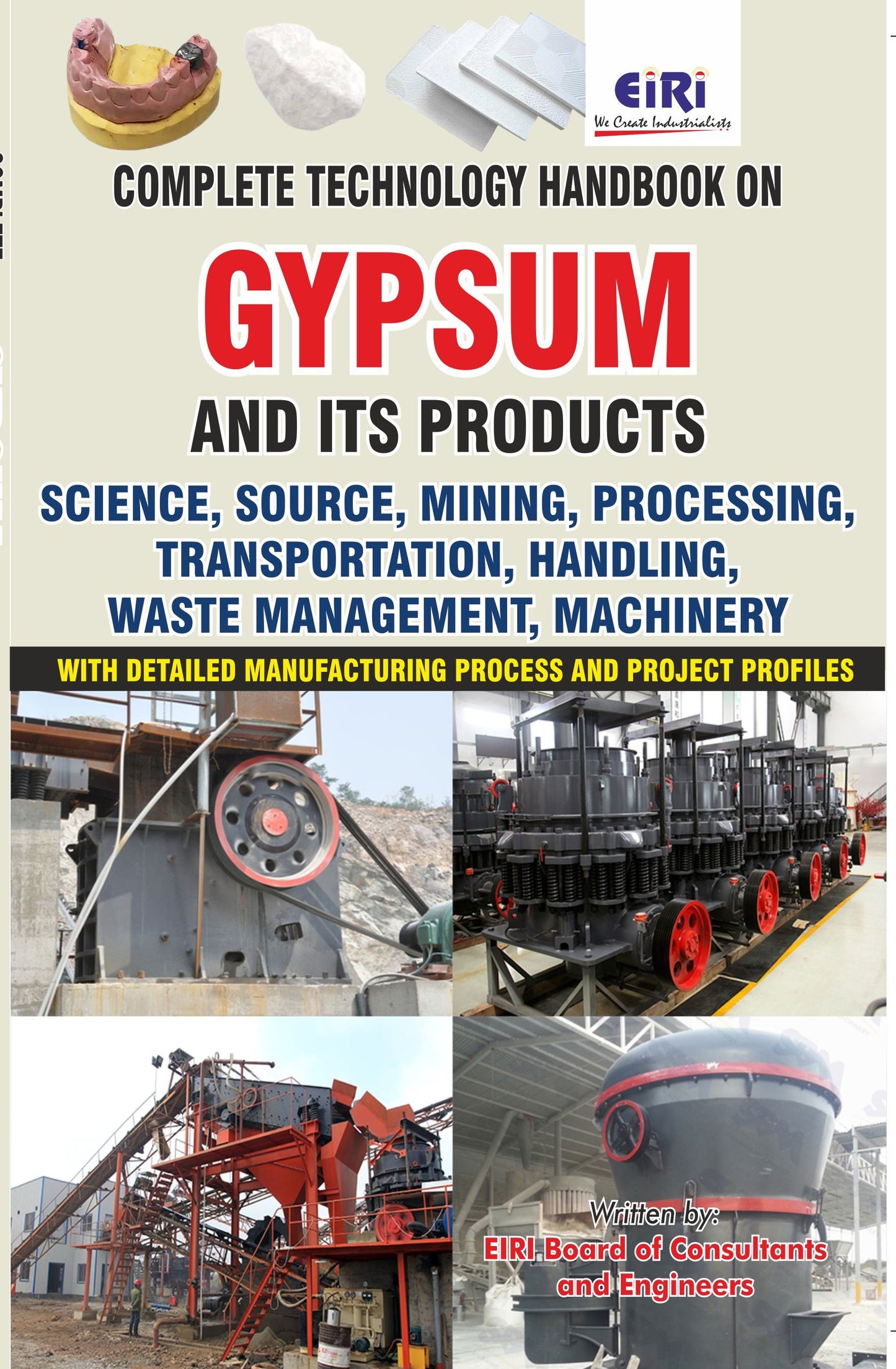
Complete Technology Handbook On Gypsum And Its Products (Science, Mining, Processing, Transportation, Handling, Machinery) With Detailed Manufacturing Process And Project Profiles
Complete Technology Handbook On Gypsum And Its Products (Science, Mining, Processing, Transportation, Handling, Machinery) With Detailed Manufacturing Process And Project Profiles
Couldn't load pickup availability
About This Book
Complete Technology Handbook on Gypsum and its Products (Science, Mining, Processing, Transportation, Handling, Machinery) with Detailed Manufacturing Process and Project Profiles (Engineers India Research Institute, ISBN 9788189765729) covers gypsum from deposit through calcination to boards, plasters and agricultural products.
Material sections cover gypsum occurrence and physico-chemical properties, the chemistry of gypsum product formation and the setting mechanism, hydration and dissolution-precipitation theories of setting, water-powder ratio effects, setting expansion, working and final setting time with Gillmore, Vicat and loss of gloss measurement, and the crystallisation behaviour of gypsum including nucleation theory, induction period and surface free energy.
Source and processing sections cover mining exploration, deposit evaluation, drilling and sampling, and the synthetic gypsum streams including flue gas desulphurisation gypsum, phosphogypsum, titanogypsum, borogypsum, fluorogypsum and pickle gypsum with their processing routes. Calcination is covered across equipment types including batch, continuous, submerged combustion and conical kettles, rotary kilns, impact mill calciners, hammer mill systems, ring ball and roller mills and boiling furnace calcining, with production of hemihydrate, anhydrous, multiphase and autoclaved alpha plasters, alongside crushing, grinding and fineness determination.
Product sections cover plaster of Paris manufacture and applications, gypsum board chemistry and the board line from blending and forming through edge finishing, cutting and drying, with board types spanning regular, fire resistant, moisture resistant, abuse resistant, foil backed, soffit, fibre and glass mat boards, plus drywall and partition systems with design criteria and jointing levels, gypsum plasters with application procedure and thickness, gypsum in cement, dental gypsum products, and agricultural gypsum as a soil amendment. Further sections cover transport, handling and storage, board waste recycling, pelletizing, BIS specifications, plant layout and five project profiles.
Frequently Asked Questions
What does the Complete Technology Handbook on Gypsum and its Products cover?
The Complete Technology Handbook on Gypsum and its Products (EIRI, ISBN 9788189765729) covers gypsum across mineral science, processing and manufacture. Its main divisions are: gypsum properties, chemistry and setting behaviour; mining technology and synthetic gypsum sources; grinding, calcination and plaster production; plaster of Paris; gypsum board and drywall systems; gypsum plasters and the role of gypsum in cement; dental gypsum products; agricultural gypsum; transportation, handling and storage; board waste recycling and pelletizing; BIS specifications, process flow and plant layout; and five project profiles with capital and turnover figures.
Who is this gypsum technology handbook written for?
This handbook is written for readers who need processing and product detail across the gypsum chain. Its intended audience includes gypsum processors and plaster manufacturers, gypsum board and wall putty producers, cement plant technical staff using gypsum as a set regulator, mining and quarry operators, agricultural input manufacturers and agronomists working with soil amendments, civil engineers and specifiers working with drywall systems, students of materials and mineral processing, technical libraries, and consultants preparing project reports.
Who should consider starting a gypsum processing business, and why?
Gypsum processing suits entrants with access to a deposit, a synthetic gypsum source or a reliable supply of imported rock, since freight on a low-value bulk mineral limits how far material can travel economically. The product ladder is wide for a single mineral: calcined plaster and plaster of Paris at the simpler end, wall putty and dry mix mortars in the middle, and gypsum plaster board at the capital-intensive end. Demand follows construction, and the shift in India from sand-cement plaster toward gypsum plaster and from brick partitions toward drywall has expanded the market for processors. Synthetic gypsum from power plants and fertiliser manufacture provides an additional low-cost feedstock stream that is often available as a disposal problem rather than a purchased raw material. The constraints are specific. Calcination is energy-intensive, so fuel cost and kiln efficiency drive the economics directly. Product quality depends on close control of calcination temperature and residence time, since over- or under-calcining changes setting behaviour and strength. Board manufacture requires substantial capital and a secure paper liner supply. Gypsum is moisture-sensitive, so storage and packaging affect shelf life. And phosphogypsum carries its own regulatory considerations that should be confirmed before it is selected as a feedstock.
What calcination methods and equipment does the book cover?
Calcination is one of the most detailed sections. Equipment covered includes batch kettles with transverse flues, continuous kettles for stucco production, submerged combustion kettles, conical kettles, co-current rotary kilns, impact mill and horizontal impact calciners, hammer mill calcination systems, ring ball and roller mills with classifiers, and conveyor kilns for anhydrite production, together with autoclaves for alpha-hemihydrate plaster. Process content covers the calcination reaction and its distinction from roasting, process description and examples, analysis of stuccos produced, and the production of hemihydrate, anhydrous and multiphase plasters. Grinding content covers pulverisers, dryer mills, hammer crushers, single roll crushers, secondary grinding applications and fineness determination.
Does the book explain gypsum board manufacturing?
Yes, through the full board line. Manufacturing content covers raw material preparation, crushing, grinding, the calcining system, stucco holding, additive blending, the mixer and forming station, forming the paper-faced sandwich, edge finishing, the board line, cut-off knife, transfer table and kiln drying, with a plant layout and activity relationship chart. Product content covers board types by performance including regular and Type X, fire resistant, moisture resistant, combined fire and moisture resistant, abuse resistant, foil backed, exterior soffit, backing, sheathing, fibre and glass mat boards, along with edge configurations, dimensional and transverse strength requirements, taper profile measurement, sampling and conformity criteria, finish, packing and marking.
What project economics does the book provide?
Five project profiles give economics, each covering land and building, plant and machinery, fixed capital, monthly working capital requirement, total capital investment and annual turnover. The projects are: calcined gypsum for plaster in the construction sector, with process description, emission control and quality of plaster produced; dry mix mortar, with formulations for internal and external plaster mortar, masonry, quick setting, high strength, repair, self-levelling and premix mortars; gypsum board and gypsum wall putty, including wall putty formulation and mixing method; gypsum plaster board; and manufacture of plaster board liners as heavy duty papers, covering the kraft paper unit from fibre and stock preparation through the paper machine to finishing and effluent treatment.
What are the agricultural uses of gypsum covered in the book?
Agricultural use is covered at length as a distinct market. Content covers gypsum as a source of calcium and sulfur, its effect on soil physical properties including crusting, compaction, structure, water infiltration, runoff and erosion, and its chemical effects including reclamation of sodic soils, exchangeable sodium percentage, calcium to magnesium ratio, clay dispersion index, subsoil acidity correction and reduction of heavy metal and salinity toxicity. Further content covers recognition of gypsum-responsive soils, use as a soil conditioner, landscape and sports field application, animal bedding and manure treatment, crops known to benefit, and pelletized gypsum production with disc pelletizers, pin mixers, rotary dryers, binder selection and application guidance.
Does the book cover gypsum board waste and recycling?
Yes. Waste content covers reuse and recycling of gypsum and gypsum boards, the recycling process and technology, policy instruments used to promote recycling, action on board waste, and construction and demolition waste management practice. This connects to the pelletizing section, where recovered gypsum is processed into pellets for agricultural use, and to the synthetic gypsum sections, where by-product streams from power generation and chemical manufacture are treated as feedstock rather than waste. Handling and storage content covers packaging, shelf life, storage types and safety measures, riser placement to prevent sagging of stored panels, manual and mechanical handling, and loading for rail and road transport.
Share