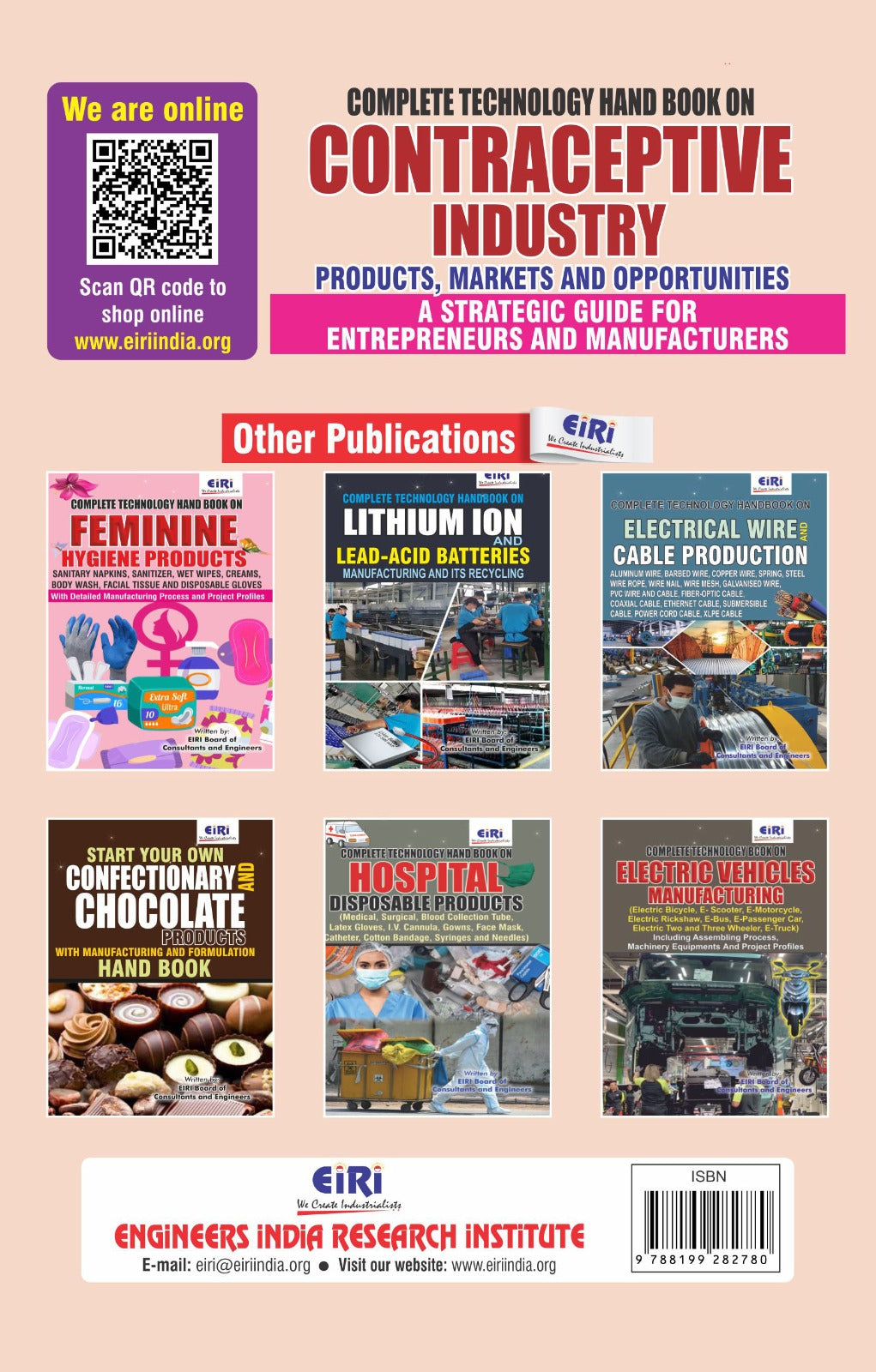
Complete Technology Handbook on Contraceptive Industry: Products, Markets and Opportunities (A Strategic Guide for Entrepreneurs and Manufacturers)
Complete Technology Handbook on Contraceptive Industry: Products, Markets and Opportunities (A Strategic Guide for Entrepreneurs and Manufacturers)
Couldn't load pickup availability
Complete Technology Handbook on Contraceptive Industry: Products, Markets and Opportunities (A Strategic Guide for Entrepreneurs and Manufacturers) (Engineers India Research Institute, ISBN 978-8199282780) covers contraceptive product manufacture alongside the market and regulatory landscape, organised product by product.
Product sections cover each category in turn with its composition and formulation, the manufacturing process, regulatory classification, key suppliers and manufacturing hubs, packaging, storage and shelf life, demand segments and pricing tiers. Categories covered include combined oral contraceptive pills, progestin-only pills, emergency contraceptive pills, injectable contraceptives, hormonal implants, copper and hormonal intrauterine devices, transdermal patches, vaginal rings, male and female condoms, diaphragms, cervical caps and sponges, spermicides and vaginal gels, and fertility tracking devices including ovulation test kits.
Industry sections cover the global market with its dynamics, trends and leading players, the value chain from raw material through manufacturing, quality control, packaging, distribution and post-sale, cold chain considerations where applicable, and the public health drivers shaping demand including United Nations and World Health Organization initiatives, sustainable development goals, women's health movements and adolescent health programmes.
Business sections cover setting up a contraceptive product unit, the regulatory landscape in India through the central drug authority and the approval pathway with timelines and fees, European conformity marking, the choice between contract manufacturing and in-house production with white-label opportunities, quality assurance against international standards and good manufacturing practice, product design and innovation, packaging and brand positioning for consumer and institutional markets, institutional sales channels including tenders and social marketing organisations, retail and pharmacy distribution, online and direct-to-consumer models, exports and trade barriers, startups and venture funding, public-private partnerships, future contraceptive technology and green manufacturing including biodegradable condoms.
Frequently Asked Questions
What does the Complete Technology Handbook on Contraceptive Industry cover?
The Complete Technology Handbook on Contraceptive Industry (EIRI, ISBN 978-8199282780) covers the contraceptive sector as a business and regulatory landscape. Its main divisions are: global market overview and industry drivers; the contraceptive value chain; a product-by-product review of hormonal, barrier, device and natural methods covering composition, formulation, manufacturing process, suppliers, pricing and demand segments; setting up a manufacturing unit; Indian and European regulatory pathways; contract manufacturing and white-label options; quality assurance and standards; packaging, branding and positioning; institutional, retail, online and export sales channels; startups, funding and public-private partnerships; and future technology and sustainable manufacturing.
Who is this contraceptive industry handbook written for?
This handbook is written for readers approaching contraceptives as a commercial and regulatory proposition. Its intended audience includes formulation and production staff in pharmaceutical and medical device manufacture, entrepreneurs and companies entering contraceptive manufacture or distribution, quality assurance and regulatory affairs professionals, distributors and marketers working with institutional or retail channels, public health programme managers, students of pharmaceutical technology and management, and consultants preparing market entry studies.
Does the book include manufacturing processes and formulations?
Yes. Each product category is treated with its composition and formulation alongside the manufacturing process. Coverage includes tablet manufacture for oral contraceptives through active ingredient mixing, tablet formation, finishing and packaging with quality control; hormone synthesis, formulation and suspension for injectables; construction and manufacture of implant rods; intrauterine device frame manufacture; patch component preparation and assembly; vaginal ring material preparation, mixing and shaping; condom manufacture from latex preparation through dipping and film formation, testing and packaging, including biodegradable variants; diaphragm, cervical cap and sponge manufacture; spermicide and vaginal gel formulation and processing steps; and ovulation test kit manufacture. This is supported by quality assurance content covering production controls, product testing and analysis, international standards and good manufacturing practice. The book does not include costed project profiles with capital investment and turnover figures.
Who should consider entering contraceptive manufacturing or distribution, and why?
This sector suits entrants who already hold pharmaceutical or medical device capability, or who intend to enter through distribution and contract manufacturing rather than by building a plant. The case for the category is that demand is structural rather than discretionary, supported by public health programmes, institutional procurement by governments, non-governmental organisations and social marketing bodies, and steady retail demand across both prescription and over-the-counter segments. India is already a significant manufacturing base and exporter across several contraceptive categories, which supports both domestic supply and export routes. The constraints are regulatory rather than technical for most entrants. Hormonal products are regulated as drugs and require approval through the central drug authority, while condoms and intrauterine devices fall under medical device regulation, each with its own testing, licensing and quality system requirements. Product liability and quality failure carry serious consequences given the use case. Institutional tenders are price-driven and favour established scale suppliers. And marketing is constrained in several markets by advertising rules and by social and political sensitivities that vary considerably by region. Many new entrants therefore begin with contract manufacturing or white-label supply before committing to their own facility.
What regulatory approvals are needed to manufacture contraceptives in India?
The book covers the Indian pathway alongside the European route. Indian content covers the central drug regulatory authority and the drugs controller, their respective roles, the regulatory landscape for setting up a unit, the steps involved, approval timelines and fees, applicable rules and regulations, and the approval pathway including the new drug application process. European content covers conformity marking requirements. Product classification determines the route, since hormonal contraceptives are regulated as pharmaceuticals while condoms, intrauterine devices and similar items are regulated as medical devices under their own rules. Readers should confirm current requirements and classification directly with the relevant authority before committing capital, as device and drug rules in India have been substantially revised in recent years.
What sales and distribution channels does the book cover?
Channel coverage is one of the book's stronger sections. Institutional content covers tender requirements for bidders, non-governmental and international health organisations, and social marketing organisations that distribute at subsidised prices. Retail content covers chain pharmacies and independent chemist networks, the differences between them, how pharmacies expand access, and the distinction between over-the-counter and prescription-only supply. Digital content covers online and direct-to-consumer models, subscription providers, telehealth services for prescription products, app-based natural methods, and the legal and marketing limits that apply. Export content covers market growth drivers, regional and product insights, regulatory and non-tariff barriers, labelling requirements, illicit trade, and relevant trade agreements.
Does the book cover contract manufacturing and white-label options?
Yes, as a distinct route to market. Content covers the comparison between contract manufacturing and in-house production, the types of company providing contract services including specialists in particular contraceptive categories and Indian contract manufacturers serving global markets, and white-label opportunities with the products available through that route and the benefits for a business entering the category without its own facility. This is supported by quality assurance content covering manufacturing and production controls, product testing and analysis, supply chain and post-market surveillance, international standards and good manufacturing practice, and common pitfalls.
What does the book say about future contraceptive technology?
Forward-looking content covers male contraceptive research and development including hormonal and non-hormonal approaches, gels and injectables, and the safety, effectiveness and cultural adoption questions attached to them, along with market readiness and investment potential. Further content covers biotechnology and slow-release delivery, smart contraceptive devices, artificial intelligence-based fertility tracking applications and wearables with how they work and their limitations, digital health integration with contraception, startup activity across device development and digital health, venture funding and pitch trends, and sustainability through green manufacturing, biodegradable condom production and reduction of hormone leaching into the environment.
Share