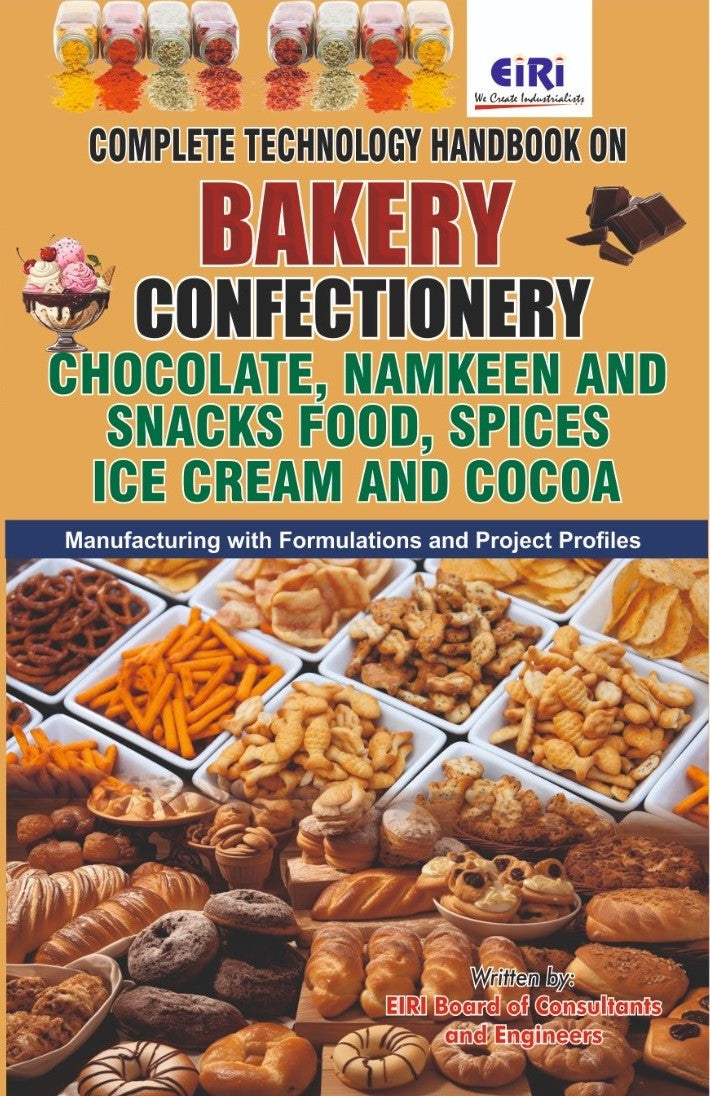
Complete Technology Handbook On Bakery, Confectionery, Chocolate, Namkeen And Snacks Food, Spices, Ice Cream & Cocoa Manufacturing With Formulations And Project Profiles
Complete Technology Handbook On Bakery, Confectionery, Chocolate, Namkeen And Snacks Food, Spices, Ice Cream & Cocoa Manufacturing With Formulations And Project Profiles
Couldn't load pickup availability
Complete Technology Handbook on Bakery, Confectionery, Chocolate, Namkeen and Snacks Food, Spices, Ice Cream & Cocoa Manufacturing with Formulations and Project Profiles (Engineers India Research Institute, ISBN 9788189765699) covers baked goods, cocoa and chocolate, sugar confectionery and savoury snacks from ingredient function to plant costs.
Bakery sections cover bread manufacture through the sponge and dough, straight dough, liquid fermentation, no-time dough, frozen dough, continuous and Chorleywood processes, with mixing, fermentation, makeup and baking stages, staling and ropy bread, and formulations for white pan, milk, sweet, rice, egg, French, rye, Vienna, whole-wheat, cinnamon raisin, naan, cheese and low sodium breads. Biscuit sections cover raw materials from wheat flour and gluten through sugars, fats, emulsifiers and chemical leaveners including ammonium and sodium bicarbonate, acid calcium phosphate and sodium acid pyrophosphate, followed by cracker, semi-sweet, shortbread, sandwich and specialty biscuit recipes and cookie forming machinery including rotary moulded, wire cut and dropping machines. Icing sections cover royal, glace, fondant and buttercream types with working recipes.
Cocoa and chocolate sections follow the bean through fermentation, drying, the cut test, cleaning, breaking and winnowing, roasting including thin-film and vacuum routes, alkalization of nibs, liquor and whole beans, liquor pressing, cocoa powder and butter production, cocoa butter equivalents, replacers and substitutes, crystallization and polymorphism, lecithin manufacture, and chocolate refining and conching with five-roll refiners and viscosity measurement.
Confectionery and snack sections cover hydrocolloids, gelling agents, sweeteners and acidulants, toffee and caramel processing, hard candy and lollipop manufacture with formulations and forming lines, potato and corn chip production lines, extruded and popped snacks, savoury crackers with numbered recipes, pickles and Indian namkeen items, closing with ten project profiles.
Frequently Asked Questions
What does the Complete Technology Handbook on Bakery, Confectionery and Snacks cover?
The Complete Technology Handbook on Bakery, Confectionery, Chocolate, Namkeen and Snacks Food, Spices, Ice Cream and Cocoa Manufacturing (EIRI, ISBN 9788189765699) covers four connected food categories. Its main divisions are: bakery technology including bread, biscuits, crackers, cookies, cakes and buns; bakery ingredients covering flour, sugars, fats, yeast, dairy, eggs, fruits, nuts and spices; icing and decoration; cocoa bean processing through to cocoa mass, powder and butter; chocolate refining and conching; sugar confectionery including hard candy and lollipops; savoury snacks, chips and namkeen; and ten project profiles with capital and turnover figures.
Who is this bakery and confectionery technology handbook written for?
This handbook is written for readers who need formulations, process parameters and machinery detail rather than home baking guidance. Its intended audience includes bakery and confectionery production staff, product development and food technologists, chocolate and cocoa processors, snack and namkeen manufacturers, students of food technology and baking science, technical libraries, and entrepreneurs or consultants preparing project reports for a bakery, biscuit, confectionery or snack unit.
Who should consider starting a bakery, snack or confectionery manufacturing business, and why?
Food manufacture in these categories is among the more accessible manufacturing entries, and suits entrants who can pair basic process capability with local distribution. The case is practical: entry is possible at several scales, from a small bakery or namkeen unit serving a local market up to an automated biscuit or chocolate compound plant; equipment is widely available domestically and second-hand markets exist; demand is repeat, non-discretionary and less cyclical than industrial products; and regional taste preferences protect local manufacturers against national brands in savoury snacks and fresh bakery in a way that rarely applies in other industries. The constraints are specific and often underestimated. An FSSAI licence is mandatory, and food safety, hygiene design and traceability requirements shape the plant layout from the start. Shelf life determines the whole business model, since fresh bakery needs daily distribution while biscuits and confectionery need packaging investment instead. Input costs for wheat flour, sugar, edible oil and cocoa move sharply and are difficult to pass on quickly. And margins on commodity products are thin, so most successful small units compete on freshness, regional taste or contract supply rather than on price.
Does the book include actual formulations and recipes?
Yes, extensively. Bread formulations cover white pan, milk, sweet, rice, egg, French, rye, Vienna, whole-wheat, cinnamon raisin, date-nut, fruit loaf, naan, cheese and low sodium varieties. Biscuit and cookie recipes cover soda and savoury crackers, matzos and water biscuits, puff biscuits, semi-sweet and Garibaldi types, shortbread, almond, walnut, coconut, rice, corn flour, coffee, semolina and chocolate vanilla varieties, sandwich types and wafer formulations. Confectionery formulations cover a range of lollipop and hard candy variants. Snack cracker sections give numbered recipes for cheese, vegetable, herb, wheat and oyster cracker types, alongside pickle formulations and Indian savoury preparations.
What does the book explain about cocoa and chocolate processing?
Cocoa coverage runs from farm to finished mass. Bean sections cover botanical types, pod breaking, fermentation and its microbiology, natural sun and greenhouse drying, the cut test, packing, shipment and infestation. Processing sections cover raw bean cleaning, roasting including the micronizer and nib roasting, sterilization, winnowing with machine fractions, nib grinding by ball and bead mill, liquor heat treatment, and flavour development through thin-film roasting with air scrubbing or vacuum. Alkalization is covered for nibs, liquor and whole beans with alkalizing ingredients. Further sections cover liquor pressing parameters, expeller pressing, cocoa grinding and fineness, drinking and instant cocoa, cocoa powder composition and microbiology, cocoa butter production, refining and deodorization, cocoa butter equivalents, replacers and substitutes, and chocolate refining and conching.
Does the book include project economics and cost data?
Yes. Ten project profiles give economics, each covering land and building, plant and machinery, fixed capital, monthly working capital requirement, total capital investment and annual turnover. The projects are: an automatic bakery producing puffs and croissants; bakery premix for cake, bread, muffins and rusk; a biscuit manufacturing unit; a chocolate compound plant; cocoa products including couverture, cocoa butter, cocoa powder, chocolate spread and chocolate syrup; a confectionery manufacturing plant; cookies making; ice cream stabilizer; namkeen and chips manufacture; and a spices or masala unit.
What snack and namkeen production technology does the book cover?
Snack coverage spans fried, extruded and baked routes. Potato chip content covers destoning, peeling, slicing, colour treatment, frying, salting, cooling, sorting and packaging, with a fully automatic production line specification. Corn snack content covers material preparation, puffing of the cornmeal mixture, cutting, drying, flavouring and packaging, along with puff corn formulation, corn chips and simulated cassava-based chips with process flow. Further sections cover meat-based snacks, a wide range of pickled products with formulations, and Indian savoury preparations including namakpare, alongside snack cracker production recipes and machinery for powder mixing, sprinkling, chocolate coating with cooling tunnel and dough sheeting.
Does the book cover bakery ingredients and food additive standards?
Yes. Ingredient sections cover sugar forms and manufacture, liquids and eggs, chemical and biological leavening agents, shortening classification across animal, vegetable and compound types with bread, pie base and creaming grades, flour, milk and milk products, butter, yeast types across baking, cooking and brewing use, salt and its multiple functions, spices with botanical names, flavourings and cocoa. Dairy sections cover milk solids, whey and buttermilk solids, fermented dairy, fractionated butterfat, cheese classification for baking, and FSSAI standards and testing for milk products. Regulatory content covers food additives permitted in bakery products under CODEX with their limits by product category, contaminants, hygiene, packaging, labelling, nutrition labelling and health claims.
Share