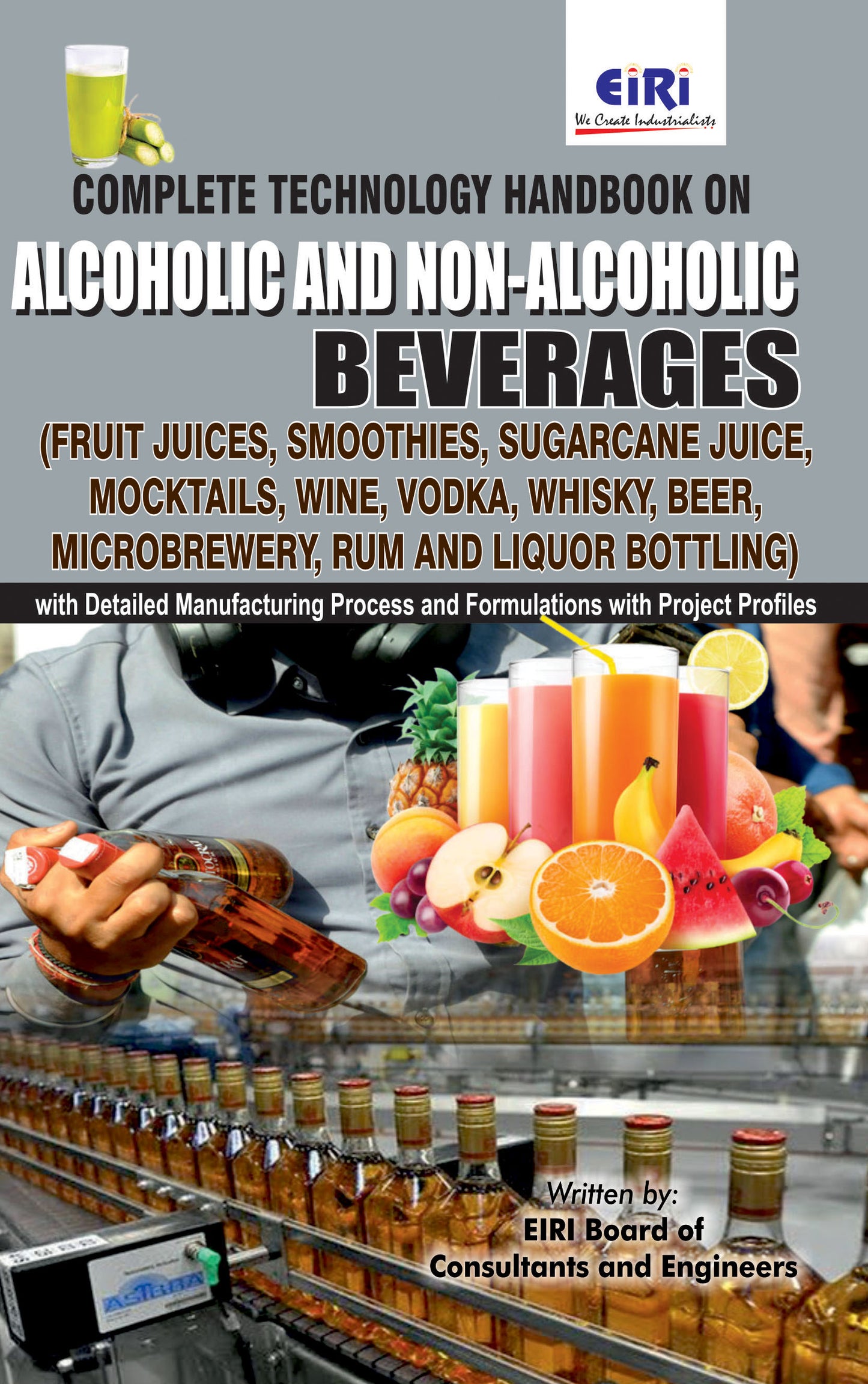
Complete Technology Handbook On Alcoholic And Non-Alcoholic Beverages (Fruit Juices, Smoothies, Sugar- Cane Juice, Mocktails, Wine, Rum And Liquor Bottling) With Detailed Manufacturing Process And Formulations With Project Profiles
Complete Technology Handbook On Alcoholic And Non-Alcoholic Beverages (Fruit Juices, Smoothies, Sugar- Cane Juice, Mocktails, Wine, Rum And Liquor Bottling) With Detailed Manufacturing Process And Formulations With Project Profiles
Couldn't load pickup availability
Complete Technology Handbook on Alcoholic and Non-Alcoholic Beverages (Fruit Juices, Smoothies, Sugarcane Juice, Mocktails, Wine, Rum and Liquor Bottling) with Detailed Manufacturing Process and Formulations with Project Profiles (Engineers India Research Institute, ISBN 9788189765835) covers beverage manufacture across both categories in 29 chapters.
Opening chapters address beverage types, market context and the licences required to operate in India, followed by carbonated beverage production covering sweeteners, acids, emulsifiers, stabilisers and clouding agents, syrup preparation, carbonation and filling, and carbonation measurement. A flavourings chapter covers emulsion classification, production methods and stability, true fruit and imitation flavours, beverage emulsion formulation, and flavour extraction and analysis by solid phase extraction, SPME, steam distillation, supercritical fluid and microwave-aided methods.
Juice chapters work through each fruit in production sequence. Grape juice covers cultivars, juice chemistry, hot-break and cold-press routes, tartrate precipitation, enzyme clarification and aseptic processing. Citrus processing covers fruit reception, grading, extractor types, oil recovery, deoiling by centrifuge, pasteurisation, deaeration, evaporator systems, essence recovery and aseptic bulk storage. Further chapters cover apple juice with ultrafiltration and pomace by-products, tropical fruits including kiwi, guava, mango, passion fruit, pineapple, acerola, banana, lulo and papaya with processing flowcharts and machinery, smoothie and mocktail formulations, and sugarcane juice with aseptic packaging.
Alcoholic beverage chapters cover whisky malting, mashing, pot still and continuous distillation, maturation and blending; beer brewing, hopping, fermentation types, maturation, defects and off-flavour correction, and beer styles; vodka, rum and table wine production; microbrewery setup and equipment; and country liquor and IMFL bottling. Eleven closing chapters give plant economics.
Frequently Asked Questions
What does the Complete Technology Handbook on Alcoholic and Non-Alcoholic Beverages cover?
The Complete Technology Handbook on Alcoholic and Non-Alcoholic Beverages (EIRI, ISBN 9788189765835) covers beverage production from fruit reception to bottling across both product categories. Its main divisions are: beverage types, market context and Indian licensing; carbonated beverages; flavourings and beverage emulsion technology; grape, citrus, apple and tropical fruit juice processing; smoothies and mocktails; sugarcane juice and aseptic packaging; whisky, beer, vodka, rum and wine production; microbrewery technology; country liquor and IMFL bottling; and eleven plant economics chapters covering project costs.
Who is this beverage technology handbook written for?
This handbook is written for readers who need process detail and equipment specification rather than a consumer guide to drinks. Its intended audience includes food and beverage technologists, juice and fruit processing plant staff, brewers, distillers and winemakers, production and quality control personnel, students of food technology and fermentation science, technical libraries, and entrepreneurs or consultants preparing project reports for a juice, brewery or bottling unit.
Who should consider starting a beverage manufacturing business, and why?
The two halves of this sector suit very different entrants. Non-alcoholic beverage manufacture — fruit juices, smoothies, sugarcane juice and packaged water — suits entrants near a reliable fruit supply who can manage a cold chain, because the main requirements are an FSSAI licence, food-grade processing equipment and route to market, and units can start small with RTS beverages before adding concentrate or aseptic capability. Alcoholic beverage manufacture is a different proposition: it is governed by state excise law rather than food regulation alone, licences are limited in number and expensive, and in several Indian states policy can change with government. It suits entrants with capital, patience for licensing, and preferably prior industry experience — though microbreweries and craft segments have opened a lower-capital route in states that permit them. Common constraints across both halves are seasonal raw material availability and pricing, short shelf life without aseptic or hot-fill capability, high packaging cost as a share of unit cost, and distribution economics that favour scale.
Does the book cover fruit juice processing in detail?
Yes. Juice processing is the largest section of the book. Coverage includes general steps such as disintegration, hot break, mash enzyme treatment, straining, clarification and deaeration, followed by fruit-specific chapters. Citrus content covers extractor types including squeezer and reamer designs, low-oil extraction, screw-type finishers, not-from-concentrate production, vacuum flashing, centrifugal deoiling, tubular, plate and cassette evaporators, essence recovery and aseptic bag-in-box storage. Tropical fruit content gives flowcharts and machinery detail for kiwi, guava, mango, passion fruit, pineapple, acerola, banana, lulo and papaya, including RTS beverage formulation and whey-based banana beverages.
What alcoholic beverages does the book explain how to produce?
The book covers the major categories separately. Whisky chapters cover malted and unmalted cereals, mashing and cooking, fermentation, pot still and continuous distillation, maturation, blending, effluent and spent grain recovery, and the organoleptically important compounds that define character. Beer chapters cover malting, brewing, hops and hopping, warm, cool and spontaneous fermentation, brewing yeasts, maturation, carbonation, filtration and bottling, plus beer defects and off-flavour diagnosis and the main beer styles. Further chapters cover vodka mash preparation, distillation, rectification and flavoured variants; rum from sugar extraction through pot and column still production, ageing, charcoal filtration and blending; and table wine including must production, alcoholic and malolactic fermentation, fining, filtration and sparkling wine methods.
Does the book include plant economics and project cost data?
Yes, more extensively than most titles in this series. Eleven chapters give plant economics, each covering land and building, plant and machinery, fixed capital, monthly working capital requirement, total capital investment and annual turnover. The projects covered are: blending and bottling of liquor from ENA; country liquor bottling; craft beer; drinking mineral water and fruit juice; extra neutral alcohol using maize as raw material; fruit juice and smoothies; a fruit juice plant for mango, orange, sweet lime, lime and pineapple at 1,200 litres per hour in tin cans; IMFL liquor bottling; a makgeolli beer plant; sugarcane juice in tetrapack; and carbonated wine with an IMFL bottling line.
What licences are needed to start a beverage business in India?
The book's opening chapter lists the licences commonly required, including a food licence, trade or eating house licence, fire department NOC, shops and establishment registration, pollution clearance, tax registrations and infrastructure licences. In practice, non-alcoholic beverage manufacture is governed principally by FSSAI registration or licensing depending on scale, while alcoholic beverage production, bottling and sale require licences from the state excise department, which vary considerably between states in cost, availability and conditions. Readers should verify current requirements with FSSAI and their state excise authority before committing capital, since excise policy is revised frequently.
Does the book cover microbreweries and craft beer?
Yes. A dedicated microbrewery chapter covers the brewing process and beer chemistry as applied at small scale, packaging, the practical questions to settle before starting a microbrewery, and the machinery and equipment required, with comparison across micro and pub brewery systems, mid-size craft and regional brewing, and large scale automated production and packaging. Stainless steel tank requirements and commercial brewing equipment options are covered, and a separate plant economics chapter gives craft beer project costs.
Share