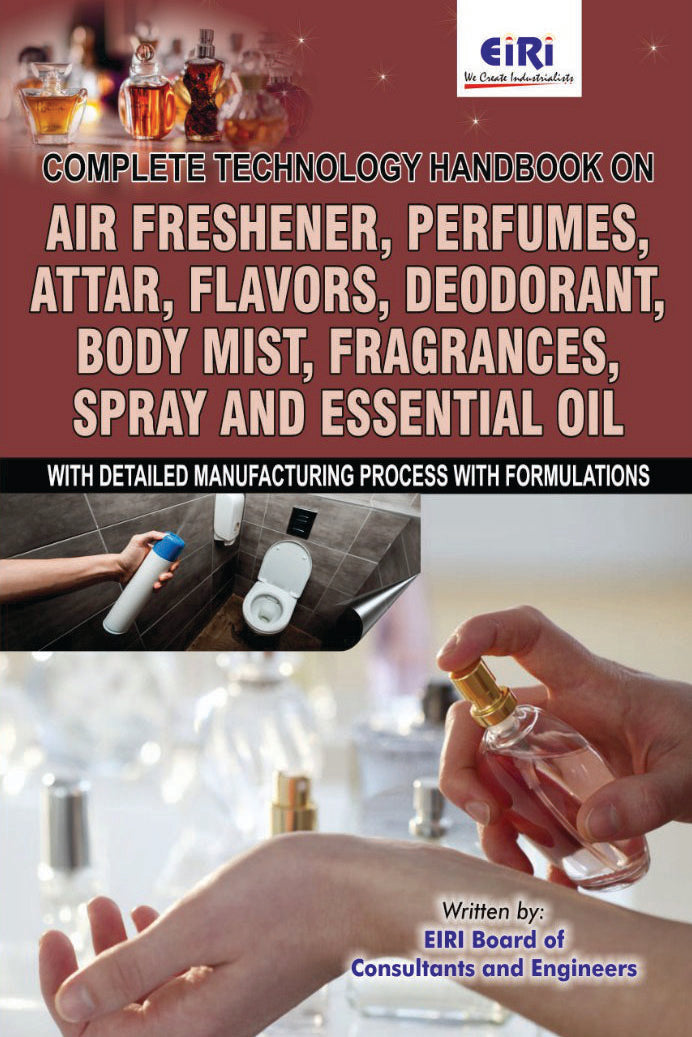
Complete Technology Hand Book On Air Freshener, Perfumes, Attar, Flavors, Deodorant, Body Mist, Fragrances, Spray And Essential Oil With Detailed Manufacturing Process With Formulations
Complete Technology Hand Book On Air Freshener, Perfumes, Attar, Flavors, Deodorant, Body Mist, Fragrances, Spray And Essential Oil With Detailed Manufacturing Process With Formulations
Couldn't load pickup availability
Complete Technology Hand Book on Air Freshener, Perfumes, Attar, Flavors, Deodorant, Body Mist, Fragrances, Spray and Essential Oil with Detailed Manufacturing Process with Formulations (Engineers India Research Institute, ISBN 9788189765040) is a formulation-led reference covering the fragrance and personal care sector across 45 chapters.
Opening chapters address the business itself: how to start a perfume venture, cost structure, brand identity, bottle selection, label and box design, cosmetic licence registration and pricing strategy. A detailed export chapter covers registration formalities including Importer-Exporter Code, GST, Export Promotion Council and ECGC, market screening and assessment, export costing, buyer negotiation, and the full documentation set from proforma invoice through bills of lading and dangerous goods forms.
Technical chapters cover aromatic sources across plant, animal and synthetic origins, and extraction technology in depth: steam distillation, solvent extraction, supercritical CO2, maceration, expression, cold and hot enfleurage, fractional distillation, and newer methods including rotary, ultrasonic and microwave-assisted extraction, solvent-free microwave extraction, headspace capture and AI-assisted fragrance creation. Product chapters cover aerosol perfume sprays with valve and can construction, antiperspirant and deodorant sticks, body mists, air fresheners, and soap perfumery with kettle and continuous soap processes.
Four large formulation chapters give working perfume compositions — floral, fantasy and imitation bases, soap compounds, and natural perfume manufacture with yields per 100 kilos. Closing chapters cover quality assurance and organoleptic evaluation, ISO 22715, ISO 22716 and ISO 16128, BIS cosmetic specifications including IS 4707-2 heavy metal limits, factory layout with value stream mapping, and plant economics for eight units.
Frequently Asked Questions
What does the Complete Technology Hand Book on Perfumes, Fragrances and Essential Oil cover?
The Complete Technology Hand Book on Air Freshener, Perfumes, Attar, Flavors, Deodorant, Body Mist, Fragrances, Spray and Essential Oil (EIRI, ISBN 9788189765040) covers the fragrance industry from raw material extraction to plant economics across 45 chapters. Its main divisions are: starting and branding a perfume business; perfume classification and aromatic sources; extraction and distillation technology; aerosol, deodorant, body mist and air freshener manufacture; soap perfumery; large formulation sections for perfumes, flower perfumes and fantasy compositions; export procedure and documentation; quality control, ISO and BIS standards; factory layout; and plant economics for eight manufacturing units.
Who is this perfume and fragrance technology handbook written for?
This handbook is written for readers who need working formulations and process parameters alongside commercial guidance. Its intended audience includes perfumers and fragrance formulation chemists, essential oil producers and distillers, cosmetic and personal care manufacturers, entrepreneurs starting a perfume, agarbatti or deodorant unit, exporters entering international fragrance markets, students of cosmetic technology and aromatic plant science, and consultants preparing project reports.
Who should consider starting a perfume or fragrance manufacturing business, and why?
Perfume and fragrance manufacture suits entrants who can either develop an olfactory skill themselves or partner with a trained perfumer, since the product is differentiated almost entirely by scent and brand rather than by plant capacity. The sector attracts entrants for practical reasons: capital requirements at the blending and filling stage are modest compared with most chemical manufacturing, since compounds can be bought and diluted rather than synthesised; the product ladder runs from low-entry items such as agarbatti compounds, body mists and air fresheners up to fine fragrance and essential oil extraction; margins on branded retail fragrance are high relative to material cost; and India has an established aromatic raw material base and export infrastructure. The constraints are equally real: fragrance is a brand-led market where distribution and marketing spend often exceed production cost; formulation skill takes years to develop or must be bought in; cosmetic manufacturing requires licensing and BIS compliance; and aerosol filling carries flammable propellant handling risks that need proper plant design.
Does the book include actual perfume formulations?
Yes, extensively. Four dedicated formulation chapters provide hundreds of working compositions. These cover imitation and synthetic bases for jasmine, rose, lavender, lilac, violet, muguet, narcissus, neroli, ylang ylang, opoponax and frangipani; tinctures and fixatives including amber, ambergris, castor and orris root; soap perfume compounds numbered by type; flower perfume formulations; natural perfume manufacture; and sophisticated or fantasy compositions including chypre, fougere and cuir accords.
What extraction and distillation methods does the book explain?
The book covers both traditional and modern extraction routes. Traditional methods include steam distillation with flow diagrams, dry and fractional distillation, solvent extraction, expression or cold pressing, maceration, and cold and hot enfleurage with equipment and step-by-step instructions. Modern methods include supercritical CO2 extraction, improved field distillation units, rotary extractors, ultrasonic extraction, microwave-assisted hydro-distillation, solvent-free microwave extraction, headspace or nature print capture, and automated and AI-assisted blending.
Does the book cover deodorants, body mists, air fresheners and aerosols?
Yes. Separate chapters cover antiperspirant and deodorant stick manufacture including active ingredients, gelling agents, batching, filling, finishing, safety and efficacy testing; deodorant classification, formulations and formats; body mist composition, water, alcohol and oil concentration, longevity and skin safety; and air freshener design including electrical plug-in units, fragrance pack and heater construction. Aerosol chapters cover propellants, valve types including bag-on-valve and metered dose, actuators, aluminium and tin can construction, and automatic filling, sealing, leak testing and capping machinery.
Does the book explain how to export perfumes from India?
Yes. A dedicated export chapter sets out the full process. Registration formalities cover bank account opening, Importer-Exporter Code, PAN, GST, Export Promotion Council and ECGC registration. Market work covers three-stage market screening and assessment, export marketing plans, pricing and export costing, and finding buyers through directories, multi-country websites, social media and chambers of commerce. Procedural content covers order confirmation, clearing and forwarding agents, port and customs formalities, shipment advice, bank document submission, export incentive claims, and the required documents including proforma and commercial invoices, packing list, certificates of origin and free sale, bills of lading, air waybill and dangerous goods forms.
What plant economics and project data does the book provide?
Eight chapters give plant economics, each covering land and building, plant and machinery, process flow diagrams, fixed capital, monthly working capital requirement, total capital investment and annual turnover. The units covered are: aerosol deodorant; agarbatti synthetic perfumery compounds including champa, mogra, sandalwood and loban; essence and flavour used in pan masala; essential oil extraction by steam distillation, solvent extraction and supercritical fluid extraction; herbal extract and essential oil; industrial fragrance and flavour for detergents, cosmetics, juices and ice cream; a perfume manufacturing unit; and scent and perfume production.
Share